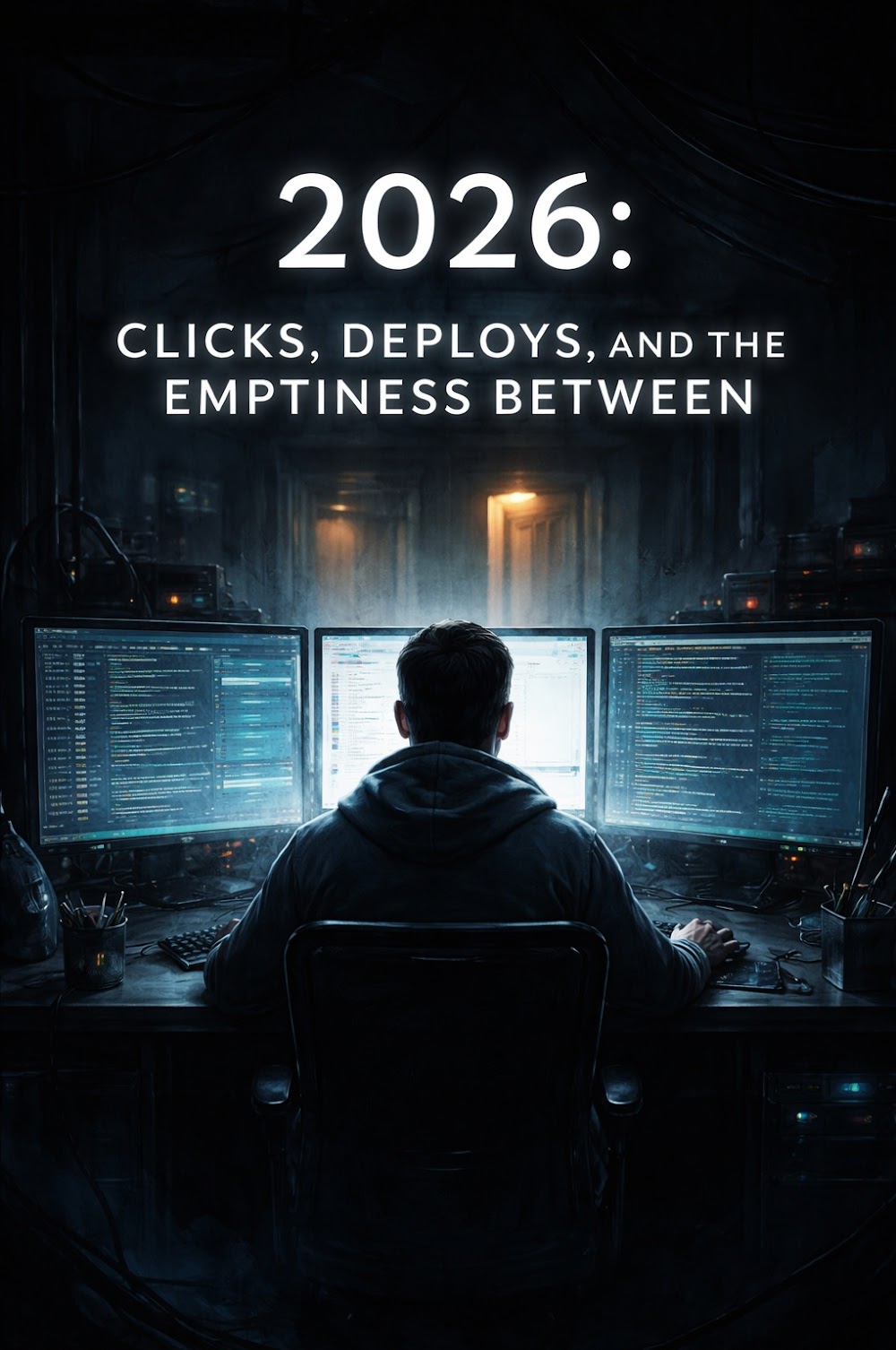
2026: Clicks, Deploys, and the Emptiness Between

The start of 2026 has a funny way of forcing reflection.
Somewhere between holiday leftovers and unopened PRs, it hit me. I’ve been in web development for seven to eight years now.
Before joining my current company four years and three months ago, I was working with the traditional stack at the start of the pandemic. Fresh out of losing my job at Citylight Hotel, I took on freelance projects, building websites and small applications using PHP, Laravel, MySQL, JavaScript, and Bootstrap. Every project was a lesson, and every client question was a test of patience and creativity.
Four years ago, I officially joined my current company as a frontend developer. I shipped features, debugged UI, and learned the basics of modern frontend frameworks. Over time, my stack evolved dramatically.
From “Just Make It Work” to “How Should This Scale?”
What began as straightforward frontend work slowly evolved. React entered the picture. Then Next.js. Then questions that didn’t exist before:
- Should this page use SSR or CSR?
- How do I handle dynamic SEO, meta tags, and schema?
- How do I optimize images, caching, and performance?
- How do I manage connection-aware UI for slow users?
- How do I handle rerouting, frontend validation, and multi-domain/subdomain setups?
Suddenly, frontend was not just UI; it was architecture, rendering strategy, performance, caching, and data flow.
I found myself working with:
- TanStack Query for fetching, caching, and synchronizing data
- Performance monitoring and optimizations, including server and client-side caching strategies
- Connection-aware components, adapting pagination, animations, images, and auto-refresh depending on network speed
- Analytics dashboards, SSR/CSR decisions, rerouting logic, and frontend validation
I also started writing my first YAML and YML files to create CI/CD flows, managing environment variables, secret keys, deployment pipelines, and Docker containers for streamlined development and deployment.
Backend Work and Full-Stack Growth
Somewhere along the way, I became a backend developer too. Working with Supabase, Firebase, AWS, Cloudflare, and Node.js, I built APIs, implemented CRUD operations, patched updates, simulated requests in Postman, and designed microservices using MongoDB.
This shift came naturally through pairing with backend and DevOps teammates, collaborating on architecture, testing, and deployment workflows.
AI and Developer Productivity
AI tools became a crucial part of the workflow. Being introduced to Cursor AI, after already using Gemini and Copilot, felt like having a constant junior developer on hand. I use AI to:
- Review and summarize code
- Generate and validate unit and integration tests
- Spot bugs and edge cases
- Get high-level performance and architecture insights
It’s not about reliance; it’s about collaboration, speed, and smarter development.
Remote Work That Actually Works
Working from home for years also means my setup matters. My main system is AMD Ryzen 7 5700X, 32GB RAM, 1TB NVMe SSD, AMD Radeon RX 7700, running on an Acer Aspire 5 laptop, with a 32” ultrawide main monitor and a 27” vertical monitor. Backup system, internet, and power are robust:
- PLDT FIBR 500–600 Mbps (Main)
- Globe FIBR 200–300 Mbps (Backup)
- 2 × 20,000mAh DC UPS for internet modems
- CyberPower UPS units for system and monitors
This setup allows me to stay hyper-focused on coding, testing, optimizing SSR/CSR, caching, rerouting, analytics, connection-aware UI, and frontend validation without downtime, ensuring reliable, high-quality output every day.
When Stability Becomes Stagnation
Startups eventually stabilize. That’s a good thing. But stability can quietly turn into repetition.
By 2026, I noticed:
- Familiar features being rebuilt in slightly different forms
- Fewer unknown technical problems
- Wearing multiple hats, but learning less from each one
Reflection on Growth
And now, as I sip my coffee in 2026, staring at my monitors, glancing at AWS dashboards, the domains I’ve set up, backend repositories, hooks, microservices, and a new design waiting for implementation, I pause.
I block an IP here, allow a region there, purge a domain, renew a payment, tweak frontend validation, adjust a layout in the new design… the tasks flow seamlessly, almost hypnotically.
The screens glow, dashboards blink, requests keep coming, logs scroll endlessly… and a quiet emptiness creeps in, like a shadow stretching across the room.
Wait. Backend? DevOps? Analytics? CI/CD? Frontend validation? New design? What… what am I even now?
Another notification pops up. Another task. Another domain. The hum of servers becomes a low, persistent growl. Something stirs in the corner of the room. Not a shadow, not a person… just the pull of responsibility, expectation, and code, whispering my name.
I feel the weight of four years, three months, and all the years before that-the PHP, Laravel, MySQL, Bootstrap, JavaScript, the freelance nights at the start of the pandemic, the slow evolution into React, Next.js, Supabase, Firebase, Vercel, Cloudflare, AWS, the endless performance tuning, SSR, CSR, image optimizations, caching concerns, rerouting, TanStack Query, connection-aware UI, microservices, Postman simulations… all of it condensed into this room, into these screens, into these glowing lines of code.
Should I stay here, steady and known, or step into the unknown somewhere else, chasing not just growth, but recognition, challenge, and a place that sees the work I truly do?
I sip my coffee again. The monitors reflect my face back at me, pale in the blue light. I adjust a configuration file, watch a CI/CD pipeline complete, patch an API endpoint, validate the new frontend input, tweak the design to catch an edge case… the room is alive, humming, whispering.
It’s time to reap what I’ve truly become. If they don’t, then we fade into someone else’s darkness. The emptiness stretches longer, the glow of dashboards flickers like a pulse. Somewhere in the silence, something calls-a door suddenly opens, a challenge waiting, an opportunity almost palpable, shifting just beyond the edge of certainty.
I stretch, lean back, and take a slow breath. The code scrolls. Notifications ping. A new ticket pops in. A domain requires renewal. A user reports an edge case. A test fails.
And then, finally, I move my hand over the keyboard, the cursor blinking, waiting for action. My heart thuds in rhythm with the blinking caret. I pause. I hesitate. I glance at the doorway where light leaks in, feel the hum of servers around me, hear the faint whisper of lines of code…
Something is waiting. Something is calling. And maybe, just maybe, it’s time to step.