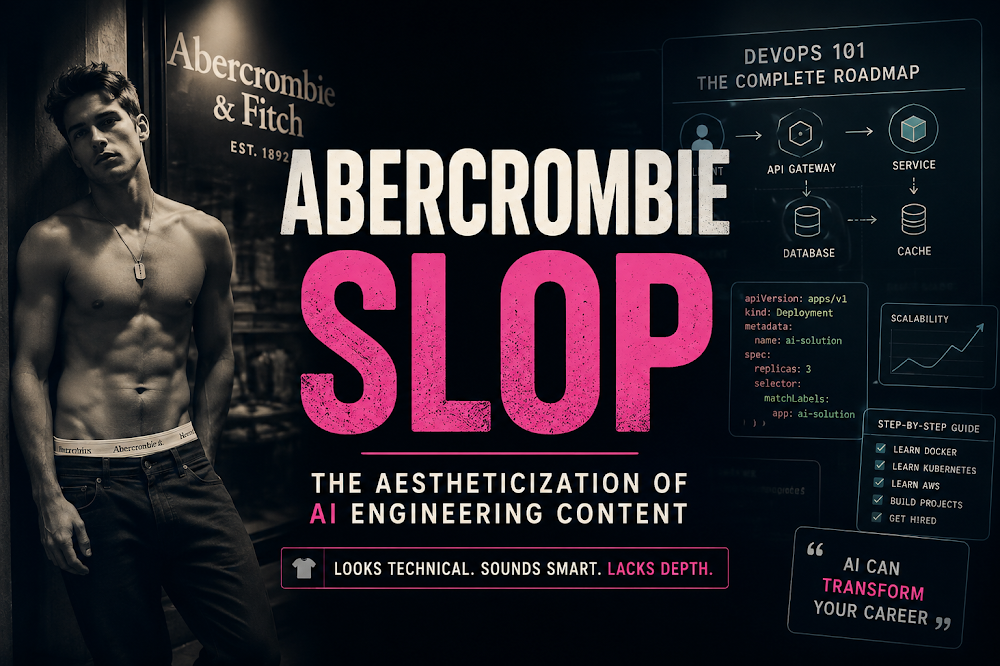
Abercrombie Slop: The Aestheticization of AI Engineering Content
People are shipping vibe-coded content the same way Abercrombie shipped male models in the 2000s.
I'm officially rebranding AI slop to Abercrombie Slop.
There's a very specific type of tech content spreading across LinkedIn, X, Medium, and YouTube right now.
It looks educational.
It sounds authoritative.
It's covered in architecture diagrams, YAML snippets, Kubernetes logos, AI-generated illustrations, and titles like:
- "DevOps Roadmap 2026"
- "The Complete Backend Engineering Guide"
- "System Design Explained in One Image"
- "Learn Kubernetes in 15 Minutes"
At first glance, it feels useful.
But if you spend enough time around actual engineers, you begin to notice something strange.
A lot of it isn't teaching engineering.
It's performing engineering.
The Engineering Influencer Industrial Complex
The modern AI stack has made content production absurdly cheap.
Need an infographic?
Ask an LLM.
Need a diagram?
Ask an image model.
Need an article?
Ask another LLM to generate 2,000 words and sprinkle in some industry buzzwords.
Need credibility?
Add a Kubernetes logo, a cloud icon, and a diagram with arrows pointing at boxes.
Congratulations.
You now have a "DevOps thought leadership" post.
The result is a flood of content optimized for engagement rather than understanding.
It looks technical enough to impress beginners.
It sounds technical enough to survive a quick skim.
But it often lacks the one thing educational content actually needs:
Depth.
The Abercrombie Analogy
In the early 2000s, Abercrombie & Fitch wasn't really selling clothing.
They were selling an aesthetic.
The dim lighting.
The cologne.
The six-pack abs.
The carefully curated image.
The clothes were almost secondary.
The product was the vibe.
Today's AI-generated engineering content often follows the same pattern.
The diagram becomes more important than the architecture.
The infographic becomes more important than the explanation.
The branding becomes more important than the expertise.
The vibe becomes more important than the substance.
Thus:
Abercrombie Slop.
Content that is engineered to look like engineering.
Vibe Coding Created a New Audience
To be clear, this isn't really a criticism of vibe coding itself.
The term "vibe coding" was coined by Andrej Karpathy in 2025 to describe a workflow where developers increasingly direct AI systems through natural language rather than manually writing every line of code. The phrase became so influential that it was later recognized as a major technology buzzword and even entered mainstream dictionaries. (en.wikipedia.org)
The interesting side effect is that vibe coding created an entirely new audience of people interested in software creation.
That's mostly a good thing.
More builders is generally better than fewer builders.
The problem starts when content creators realize they can target this audience without possessing much engineering expertise themselves.
Suddenly, there is enormous demand for content that feels technical.
And AI is extremely good at producing exactly that.
The Hallmarks of Abercrombie Slop
You can usually identify it quickly.
1. The Diagram-to-Insight Ratio Is Terrible
The post contains twelve boxes and fourteen arrows.
The actual lesson could have fit into two paragraphs.
2. Everything Is a Roadmap
Every topic is presented as a neat ladder.
Learn A.
Then B.
Then C.
Then become a Staff Engineer.
Real engineering careers rarely work like that.
3. No Trade-Offs Exist
Every technology appears universally good.
Every framework appears revolutionary.
Every tool appears essential.
Experienced engineers know that trade-offs are the entire job.
4. No Failure Stories
The content only describes success.
Nobody discusses outages.
Nobody discusses debugging.
Nobody discusses the months wasted pursuing bad architectural decisions.
The messy reality gets filtered out.
5. It Explains Concepts Without Context
You can memorize every box in the diagram and still have no idea when or why to use any of it.
The “Creator Archetype” Pattern in the Wild
Beyond individual posts, there is also a recognizable content archetype that tends to appear in algorithm-driven feeds.
This archetype is not about any one person. It’s about a style of posting that AI tools make very easy to produce at scale.
It usually looks like this:
Example pattern A: The “tool launch narrative”
- “I built a transcription tool. Now I have to build recordings and streaming next.”
- “Video transcription just got easier.”
- “Install this connector in an AI assistant, turn videos into blogs, scripts, and viral content faster.”
The structure is always the same:
- A simple capability is introduced
- It is immediately expanded into an ecosystem
- Output generation becomes the main value proposition
- “Content reuse” and “automation” are framed as the product itself
The focus shifts from what problem is being solved to how much content can be generated from it.
Example pattern B: The “AI removes friction narrative”
- “AI can transcribe, but most tools still make you handle technical setup.”
- “This removes proxy issues, setup, and coding headaches.”
- “Paste a link. Upload a file. Get a transcript.”
This framing is powerful because it sounds like simplification.
But it often quietly removes the part where understanding used to live.
Everything becomes “just outcomes.”
The system disappears.
Example pattern C: The “learning disguised as storytelling”
- “Do you know what a strangler fig is?”
- “In software engineering, there’s a pattern called the Strangler Fig pattern.”
- “It’s just a way of gradually replacing legacy systems.”
This style blends curiosity hooks with simplified explanations.
It works well for engagement.
But it often compresses complex engineering trade-offs into a single digestible metaphor, stripped of edge cases and constraints.
Example pattern D: The “AI system orchestration announcement”
- “Built a DevOps/SRE AI support flow.”
- “Routes requests, handles assessments, and prepares escalations.”
- “Connected to a knowledge base.”
These are often legitimate systems.
But in content form, they are usually described at a level of abstraction that hides most of the real engineering work: failure handling, integration complexity, and operational cost.
The Irony
The funniest part is that many of these posts are generated or heavily assisted by the same systems they are describing.
We're now multiple layers deep into a recursive loop of aestheticized knowledge.
An engineer writes something.
A content creator summarizes it.
An AI model trains on the summary.
Another creator uses the AI to generate a new summary.
Then someone turns that into a LinkedIn carousel.
By the time it reaches your feed, all of the original nuance has been sanded away.
What remains is pure technical vibes.
The Final Irony
There’s one last layer worth acknowledging.
This entire essay is also a product of the system it critiques.
The structure, the phrasing, the refinements, the expansion of ideas-all of it was shaped through an AI writing tool based on rough human thoughts, fragmented examples, and intuitive frustration.
In other words:
I used the same kind of system I’m describing to articulate why systems like this feel uncanny.
That doesn’t invalidate the critique. If anything, it makes it more accurate.
Because this is exactly what the current moment looks like.
Not pure human writing versus pure AI slop.
But a hybrid space where thinking, prompting, editing, and aestheticizing blur together until the boundaries are no longer clean.
The problem was never “AI-generated content.”
The problem is what happens when everything becomes optimized for fluency, structure, and surface-level coherence-while the underlying depth quietly varies from profound to absent.
And yes, this essay is part of that ecosystem too.
That’s the uncomfortable part.
Not that AI is writing content.
But that we already are.
Just with different levels of assistance.
Substance Still Wins
The good news is that genuinely useful engineering content remains easy to recognize.
It contains specifics.
It contains trade-offs.
It contains mistakes.
It contains uncertainty.
Most importantly, it teaches you how to think rather than what to repost.
The best engineering articles often look surprisingly boring.
No dramatic graphics.
No neon cloud icons.
No AI-generated cyberpunk illustrations.
Just a person explaining a problem they encountered and how they solved it.
That's because expertise is usually less visually impressive than people expect.
Real engineering is messy.
Real engineering involves constraints.
Real engineering involves being wrong.
And that's precisely why it doesn't fit neatly into an infographic.
Conclusion
Vibe coding is real.
AI-assisted development is real.
AI-assisted learning is real.
But so is AI-assisted posturing.
We're entering an era where looking technical has never been easier.
Which means actually being technical becomes more valuable, not less.
So the next time you see a beautifully rendered diagram explaining "The Complete Software Engineering Roadmap," ask yourself a simple question:
Am I learning engineering?
Or am I consuming Abercrombie Slop?
References
- Merriam-Webster - "Vibe Coding" definition
- Andrej Karpathy - discussions on vibe coding (2025)
- Wikipedia - Vibe Coding overview
- Research on AI-assisted software development workflows and knowledge dilution effects in generated technical content