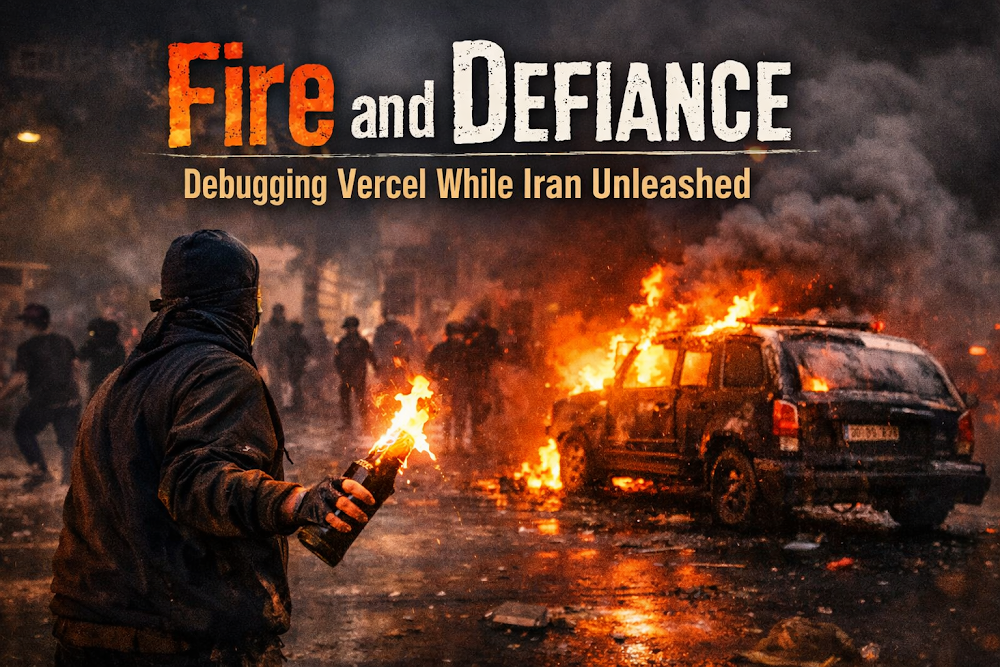
Fire and Defiance: Debugging Vercel While Iran Unleashed
While I Was Debugging Vercel, Iran Was Catching Fire
I was knee-deep in CI logs.
A Vercel deploy was failing with the most useless error message known to DevOps:
"Could not retrieve Project Settings. Remove the .vercel directory and deploy again."
There was no .vercel directory.
Of course.
Meanwhile, In the Real World
Mid-debug, I glance at the news.
Iran.
Multiple cities.
Multiple provinces.
At the center of it all stands the Supreme Leader, a system built around one man’s authority, now answering nationwide dissent with force instead of legitimacy.
Fires in the streets. Police vehicles burning. Civilians fighting back.
Reports of a full internet shutdown.
And yet the blackout didn’t hold.
People routed around it.
Starlink terminals came online. Advanced VPNs and proxy chains spread. TLS fragmentation, selective “white list” access, anything that could punch holes through state filters.
Information still leaked out.
And suddenly my terminal feels… small.
Perspective, Forcefully Applied
Here I am:
- arguing with a CLI about project visibility
- blocked because a trial might have expired
- waiting for someone to click “Invite member” in a dashboard
And somewhere else:
- people are testing the limits of state power
- fear barriers are collapsing
- history is deciding whether it wants to bend or snap
My problem was:
"Vercel cannot retrieve project settings."
Their problem is:
"The system cannot retrieve legitimacy."
Different error classes.
Debugging as a Universal Experience
What struck me wasn’t guilt, it was absurdity.
Everyone is debugging something.
- Developers debug pipelines
- Governments debug populations
- Regimes debug legitimacy
The difference is scale.
One bad deploy ruins my afternoon.
One bad decision ruins a generation.
Reported Death Tolls (as of January 11, 2026)
What filtered through the blackout was worse.
Verified human rights estimates: As of January 11, the US‑based Human Rights Activists News Agency (HRANA) reported at least 116 total deaths, including 78 protesters and 38 security personnel.
Mass casualty reports: Other outlets and eyewitnesses describe far higher numbers as the crackdown intensified. Preliminary estimates from Iran International suggest that as many as 2,000 people may have been killed in the 48 hours following the internet shutdown. These figures have not yet been independently verified. (aricle)
Hospital and medical accounts:
- Tehran: A doctor reported that six hospitals recorded at least 217 deaths on January 8 alone.
- Rasht: One hospital reportedly received 70 bodies on January 9.
- Neyshabur: A doctor reported at least 30 deaths, including a 5‑year‑old child.
Child fatalities: At least nine children have been confirmed killed during the unrest. (article)
Nature of the crackdown:
- Security forces reportedly used live ammunition, machine‑gun fire, and pellet guns, often at close range.
- Human rights groups report injured protesters being removed from hospitals, and doctors being threatened for providing treatment.
Identified victims whose deaths have been verified include Rubina Aminian (23, shot in Marivan) (link), Taha Safari (15, killed in Azna) (link), and Amirhesam Khodayarifard (22, killed in Kuhdasht) (link),.
The true toll is expected to be higher, with information continuing to surface through limited channels, many of them relying on Starlink connections and hardened circumvention tools. (article)
Trump Speaks Out
"Iran is looking at FREEDOM, perhaps like never before. The USA stands ready to help!!!" Trump said in a post on Truth Social.
Videos and social media clips are circulating showing Iranians appealing to Trump for help, desperate as their leaders continue to kill their people.
Video: Iranians in Tehran holding signs asking for international helpVideo: Citizens in Rasht chanting for interventionVideo: Social media clips showing pleas for protection from the regime

Even AsmonGold Is Talking About It
Even gaming and tech streamer AsmonGold weighed in on the chaos in Iran during his stream, highlighting the intensity of the protests and the unprecedented defiance against the regime. Viewers saw him react to videos of burning streets, Starlink deployments, and the citizens’ resilience, remarking on how surreal and terrifying the events were.
"It’s insane… these people are literally fighting for their lives while the government tries to blackout everything. You can’t even imagine what it’s like to live through this," he said.
Back to the Logs
Eventually, the root cause became clear:
Not code.
Not YAML.
Not .vercel.
Permissions.
I couldn’t see the project.
The token couldn’t see the project.

And somewhere else, millions of people were deciding they no longer wanted to be ruled by permission at all.
The streets were alive with rage. Fires licked buildings. The air smelled of smoke, tear gas, and the metallic tang of blood. Shouts, cries, and gunfire echoing down every alley. Hospitals overflowing. Children dead. A regime frozen in panic, lashing out with everything it had, bullets, threats, terror.
And yet, defiance burned brighter.
Starlink beams, VPN tunnels, clandestine messages. A network that refused to die. Information leaking like blood through a sieve. A people who had nothing left to lose and everything to fight for.
This was not a protest. This was chaos. Horror. A horror movie with no script, no director, just raw, brutal, unstoppable reality.
Meanwhile, I stared at my screen, my Vercel error still blinking, and realized: some failures are local, some are universal. Some are trivial, some are alive, dangerous, and unstoppable.
And for once, my afternoon seemed utterly meaningless in the shadow of fire and defiance.
