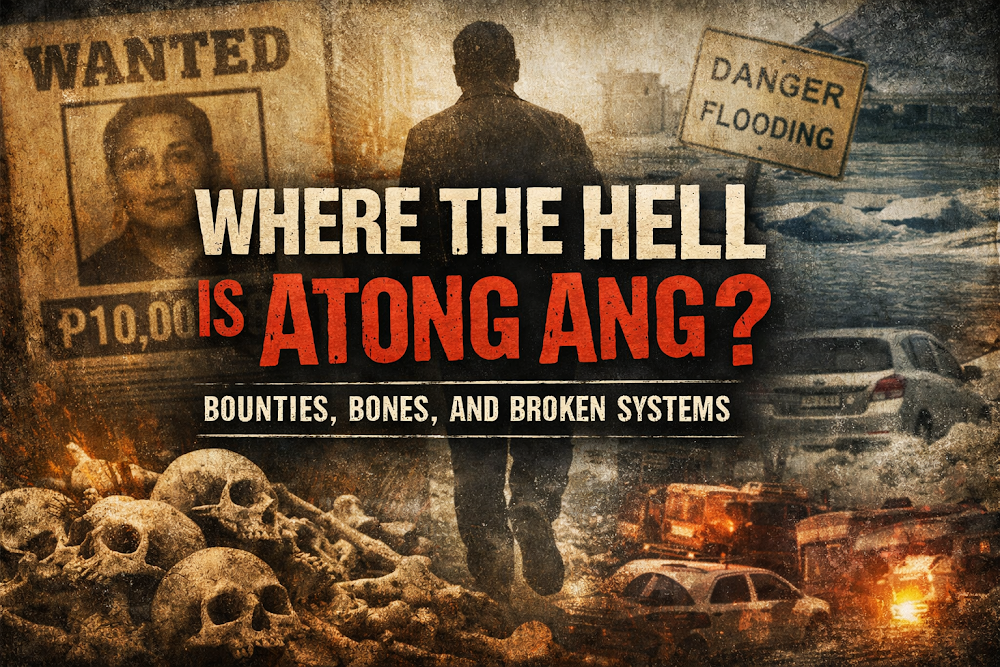
From Cockpits to Court Orders: the sabungero case that refused to die 2026
This is an opinion piece. It reflects public reporting, patterns, and institutional failures - not a verdict. If that disclaimer already annoys you, good. It should.
There are stories in this country that refuse to stay buried. No matter how much dirt you throw on them. No matter how many press releases you issue. No matter how loudly officials insist that everything is under control.
The missing sabungeros story is one of those.
I thought 2025 was the peak of the rot. (part 1)
I was wrong.
This thing didn’t end. It just waited for the country to get distracted enough.
2026: Surprise! The System Finally Noticed (Too Late, Obviously)
January 2026 didn’t bring justice. It brought panic management.
A court finally issued a warrant of arrest for Atong Ang - a name that has hovered over this case for years like an open secret everyone pretended not to hear. Not whispered anymore. Not danced around. Printed. Signed. Official.
And then came the most Philippine headline imaginable:
Not for flood victims.
Not for whistleblowers.
Not for fixing broken systems.
A bounty.
Atong Ang was suddenly described as armed and dangerous - a phrase the state loves to deploy once embarrassment reaches critical mass.
And then, in a plot twist absolutely no one saw coming:
He disappeared.
As of this writing, he can’t be found.
His lawyers say he was advised not to surrender yet. Legal remedies first. Motions. Appeals. Procedural yoga. Because here, a warrant doesn’t mean “you’re coming with us.” It means “we’ll circle back.”
If you’re poor, a warrant is immediate.
If you’re powerful, it’s a scheduling concern.
The Great Manhunt™ (Now Featuring Press Briefings)
The DILG rolled out the announcement with full cinematic energy. Police spokespeople queued up. Headlines screamed MANHUNT like we were watching a Netflix trailer.
But to anyone who’s been paying attention since 2021, the entire thing felt insulting.
Not because action is bad.
But because this is years late and suspiciously well-timed.
Men started disappearing in 2021.
Families cried on camera.
Mothers begged senators.
Fathers aged a decade in real time.
And the system?
It stalled.
It delayed.
It shrugged.
Now we’re expected to applaud because the suspect is - shockingly - difficult to locate?
You don’t say.
Reminder: Real People Actually Vanished

Family members of the missing sabungeros call for justice during a media conference in Quezon City on July 14, 2025. The group accuse business tycoon Charlie "Atong" Ang of being the mastermind behind the disappearance of the sabungeros, who may be the individuals whose remains were found submerged in Taal Lake. Mark Demayo, ABS-CBN News
At least 34 men.
Not myths.
Not internet lore.
Not Reddit horror threads.
Real people.
Sabungeros, runners, bettors - some small-time, some deeply embedded in an industry that flourished during the pandemic while everyone else was just trying to eat.
They were last seen:
- Walking into cockpits
- Escorted into vans
- Standing in parking lots they never left
This didn’t happen in jungles or no-man’s-land.
This happened in Laguna, Cavite, Batangas, Bulacan, Metro Manila.
Places overflowing with:
- CCTV cameras
- Cell towers
- Digital payments
- Police checkpoints
And yet:
No bodies.
No convictions.
No complete timelines.
Just silence, professionally maintained.
When Witnesses Spoke - Cue the Discomfort
By 2025, witnesses finally began surfacing.
Some anonymous.
Some masked.
Some given aliases that sounded absurd until you realized how necessary they were.
And the uncomfortable part?
Their accounts aligned.
They spoke of:
- Organized operations
- Coordinated movements
- Alleged disposal sites
- Instructions coming from people who don’t enjoy scrutiny
Atong Ang stopped being a rumor and became an accusation discussed in public.
That’s when the room temperature changed.
The Bones Everyone Pretended Not to See

Philippine coast guard personnel prepare to depart to the site where the bodies of cockfighters were allegedly dumped, in Lake Taal off Talisay town, Batangas province, South of Manila on July 10, 2025.
As if disappearances weren’t damning enough, October 2025 delivered a detail so horrifying it should have permanently altered the conversation - and yet somehow didn’t.
Authorities confirmed that over 880 human skeletal fragments were recovered from Taal Lake during an operation linked to the investigation of missing sabungeros.
Not rumors. Not speculation. Bones.
Fragments. Not even complete bodies.
Let that sink in.
Hundreds of skeletal remains pulled from a body of water that had already been whispered about for years as a possible dumping ground. A discovery that should have triggered national outrage, resignations, and an all-hands-on-deck reckoning.
Instead, it became another headline Filipinos were expected to absorb, scroll past, and emotionally compartmentalize.
No definitive identifications were immediately announced. No instant closure for families. Just forensic backlogs, careful language, and reminders that investigations take time.
And maybe they do.
But when hundreds of skeletal fragments surface in the middle of a case involving dozens of disappearances, pretending there’s no connection doesn’t sound like caution.
It sounds like avoidance.
This wasn’t just about missing people anymore.
This was about the physical evidence of violence existing in plain sight - and the system still struggling to look directly at it.
“Armed and Dangerous” (Aka: We Let This Rot)
When authorities label someone armed and dangerous, it’s supposed to signal urgency. (article)
What it actually signals is this:
We should have acted earlier, and now we’re improvising.
A ₱10M reward doesn’t scream efficiency. (article)
It screams reputation salvage.
Why now?
Why only after sustained pressure?
Why only when witnesses and journalists refused to drop it?
In engineering terms, this is a panic hotfix applied to a system that’s been broken for years.
Meanwhile, Back in Flooded Reality
Here’s where the absurdity becomes offensive.
While the government mobilizes resources, urgency, and media bandwidth to locate one powerful individual…
ordinary Filipinos are underwater. Again.
Flood control projects worth billions fail with clockwork precision. Roads become rivers. Homes become wading pools. Workdays disappear.
And every year, we’re served the same excuses:
- “Clogged drainage”
- “Unexpected rainfall”
- “Climate change”
Curiously absent:
- “Misused funds”
- “Ghost projects”
- “Zero accountability”
Amazing how ₱10M appears instantly for a manhunt, but flood control money evaporates without a trace.
Truly magical budgeting.
This Is Not a Bug. It’s the Architecture.
The sabungero case isn’t an outlier.
It’s the template.
- Powerful industries entangled with crime
- Victims without leverage
- Justice delayed until public embarrassment forces movement
- Action framed as heroism instead of obligation
We don’t lack laws.
We lack backbone.
We don’t lack evidence.
We lack the courage to pursue it consistently.
A Developer’s Rage Section (Because Of Course)
Online sabong was digital.
Meaning:
- User accounts
- Login histories
- Payment records
- Device fingerprints
- Server logs
In any system I’ve worked on, losing one user without logs is a failure.
Losing 34?
That’s not a mistake.
That’s a choice.
Someone turned logging off.
Someone deleted data.
Someone decided disappearance was an acceptable outcome.
And then - years later - hundreds of skeletal fragments surface.
Unidentified. Unclaimed. Fragmented.
Like commented-out code left rotting in a production system.
Not deleted. Not resolved. Just silenced with // TODO and pushed out of sight.
The bones are there, physically undeniable, but treated the same way missing logs are treated in bad systems - ignored because acknowledging them would force a rewrite of everything.
They’re the ghosts of data someone didn’t want parsed.
The evidence the system hopes no one tries to compile.
Final Thoughts: Warrants Are Not Justice
A warrant is not justice.
A bounty is not accountability.
A manhunt is not closure.
Justice would have meant intervention before people vanished.
Justice would have meant protecting families instead of exhausting them.
Justice would mean power doesn’t buy delay, silence, or plausible deniability.
As of 2026, Atong Ang is missing.
Just like the sabungeros.
If that parallel makes you uncomfortable, good.
Because the most dangerous thing in this country isn’t crime.
It’s how efficiently the system teaches us to tolerate it.
TL;DR
- 34 sabungeros disappeared starting 2021. The system stalled for years.
- Warrants and a ₱10M bounty only appeared in 2026 - when public pressure became impossible to ignore.
- Atong Ang is missing, advised not to surrender, proving power still buys time.
- Over 880 human skeletal fragments were found in Taal Lake in 2025 - real, physical evidence that should have changed everything and didn’t.
- Flood control failures show the same pattern: money vanishes, accountability doesn’t.
- In tech terms: logs were disabled, evidence ignored, and the system chose silence.
This isn’t a mystery.
It’s a design choice we’ve normalized.