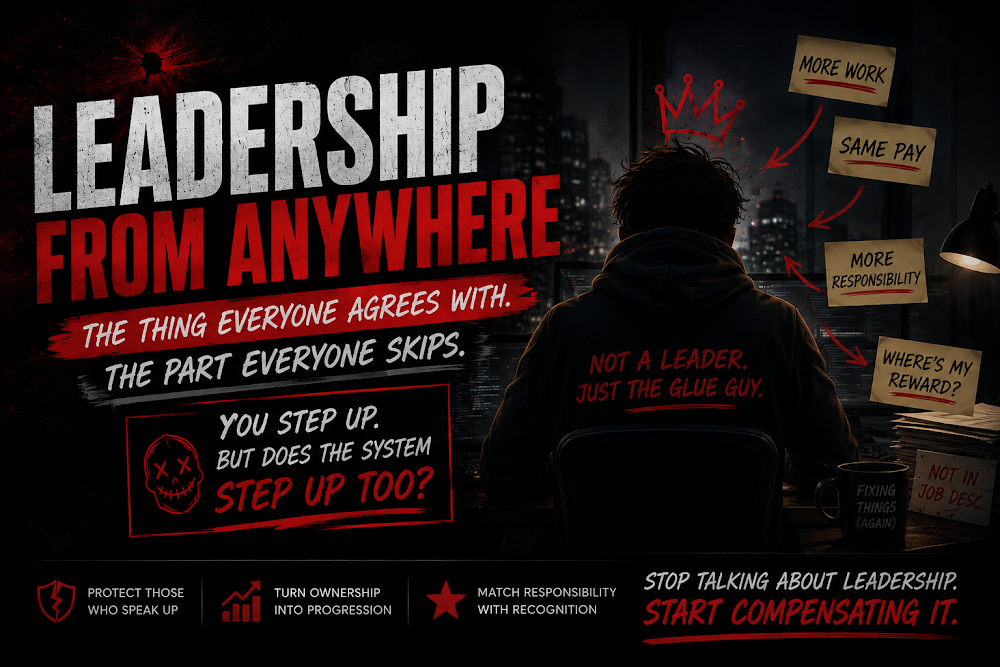
The “Leadership From Anywhere” Thingy and the Part Everyone Skips
I saw one of those classic LinkedIn posts again.
You know the type:
Leadership isn't about titles. It's about behavior. Take initiative. Speak up. Help people. Fix things. Be the quiet hero in meetings. Change the direction of projects with one well-timed question. Etc. etc. etc.
Then the comments section was basically a choir.
Executives, founders, coaches, "ex-Accenture, ex-this, ex-that" energy everywhere.
All saying the same thing in different fonts:
“Yes. Leadership is behavior, not title.”
And I'm reading it thinking… sure. Correct.
But also… incomplete as hell.
Because everyone is agreeing on the theory of leadership, while quietly ignoring the physics of how work actually flows inside companies.
The part nobody wants to say out loud
People keep repeating:
- leadership = behavior
- influence > title
- anyone can lead
Cool. True in theory.
But in real life?
Behavior exists inside systems.
And systems have incentives.
And incentives are where things get interesting.

Because the real question is not:
“Can people lead without titles?”
Kaya nila. And they already do, lol.
The real issue is if orgs actually reward initiative, protect those who speak up, turn ownership into progression, and match responsibility with recognition.
Without that second half, "leadership from anywhere" feels kulang. At best, pang-inspire lang siya. At worst, it's just a quiet transfer of responsibility pababa, without the matching transfer of authority or reward pataas, haha.
Ganito nalang: Leadership is behavior, buuuuut behavior always lives inside systems :uWu:
People will step up when:
- they feel safe doing so
- they get recognized for it
- they see a path from contribution to progression
Otherwise, initiative ends up parang unevenly extracted, not sustainably encouraged, lol.
My version of that story (not the LinkedIn version)
I worked in one place for about something-something years.
Not gonna name it. Doesn't matter.
But I was doing the classic thing:
- 110% output
- always online
- always “sure kaya pa”
- fixing stuff before it becomes a problem
- jumping between dev, coordination, support, random fire drills
- basically being the glue guy without anyone calling it that
How I ended up "leading" without deciding to
My actual manager back then was the one who shaped a lot of how I worked.
He didn't call it leadership lessons or anything cringe like that.
He just trusted me.
Like properly trusted me.
And he said it directly too.
And because of that, I started operating in a certain way:
- if something breaks, I don’t wait
- if something’s unclear, I align people
- if someone’s stuck, I unblock them
- if nobody’s talking, I connect the dots
Not because I thought I was "a leader".
I was just… there.
Online. Present. Solving things.
Gaming, movies, whatever in between.
But somehow always in front of the PC doing something.
And when I got bored?
I worked more.
Not because I'm some noble hardworking saint.
More like:
“If I can do it now, why would I suffer future-me later?”
Very anti-drama mindset. Very "future me will say thanks or else" energy.
And somehow that lifestyle + mindset just clicked in that company.
Honestly, looking back now, that environment feels like one of those systems where things can either bring out the best in people… or slowly turn them into something else entirely. Hopefully not the second one. I moved on anyway.
But to be fair — my manager wasn't some "use and abuse" type.

He was a legit leader.
The kind that actually shields his team.
He took arrows for us. Absorbed pressure from above. Protected the people under him when things got messy.
He wasn't new either — he was one of the longest-tenured people in the company.
And I think that's important to say.
Because a lot of what I ended up doing came from that kind of environment: not exploitation, but trust.
When the real shift happened
Then my manager left.
And something interesting happened.
Nobody replaced him properly.
No clean handover. No "new structure". Nothing dramatic.
So I just… continued.

Not officially. Not romantically. Not with a title upgrade montage.
Just continued doing the glue work:
- making sure people weren’t confused
- keeping dev + support aligned
- being the bridge when things didn’t match
- translating chaos into something slightly less chaotic
- basically holding the thing together in the background
Not as "leader".
More like:
“Ah si Maiko, siya usually tumutulong diyan.”
Kuya energy. Co-dev energy. Fixer energy. Background infrastructure guy.
And weirdly… I think that's how a lot of companies survive.
Not from titles.
From people quietly over-functioning.

Why I eventually left (and why it's not that deep and not my Villain Arc)
The PM leaving wasn't random either.
It was a mix of things.
Some organizational. Some personal. Some just… classic corporate friction stuff.
Nothing glamorous.
And I followed not too long after.
Not because of one big villain moment.
It was more like my brain finally accepted things, and everything just… clicked together. Parang may website na biglang nag-load in my head and everything got deployed at once.
And then:
“Ah okay. I see the direction. I think I’m good.”
No drama. No big emotional breakdown arc. Just clarity.
At some point, I realized something funny.
One day I found out my junior developer was earning more than me.
And my first reaction wasn't rage or anything dramatic.
It was more like:
“Ah. So this is how it works pala.”
Not even sarcasm. Just… data.

And to be fair, I wasn't coming in blind either — my elder sister worked in HR somewhere else, so I already had a rough idea of how compensation logic can sometimes drift away from "rank = pay" in real life. Still hits different when you see it inside your own org though.
A quiet system update in my head. No pop-up warning. Just silent acceptance that this is how the game is structured sometimes.
The uncomfortable pattern under all of this
Here's the part LinkedIn never really captures:
A lot of "leaders without titles" are just people who:
- stayed longer
- cared more
- fixed more
- tolerated more ambiguity
- absorbed more randomness
And yes, that creates value.
But it also creates a trap if the system doesn't balance it.
Because at some point:
being reliable becomes being defaulted to
And being defaulted to becomes:
permanent responsibility without permanent recognition
That's where the friction starts.
Back to the LinkedIn post
So when I read posts like:
“You can lead from anywhere”
I don't disagree.
I just mentally add:
“Yes. But what happens after?”
Because that's where reality lives.
Not in the inspiration.
Not in the comment section agreement.
But in what the system does with the people who actually step up.
Final thought
Leadership isn't fake.
Behavior matters.
Initiative matters.
Ownership matters.
But none of it exists in a vacuum.
So yeah:
Leadership is behavior.
But behavior always lives inside systems.
And systems decide whether leadership becomes:
- growth
- or workload
- recognition
- or silence
- progression
- or just “thanks, can you also fix this next thing?”
