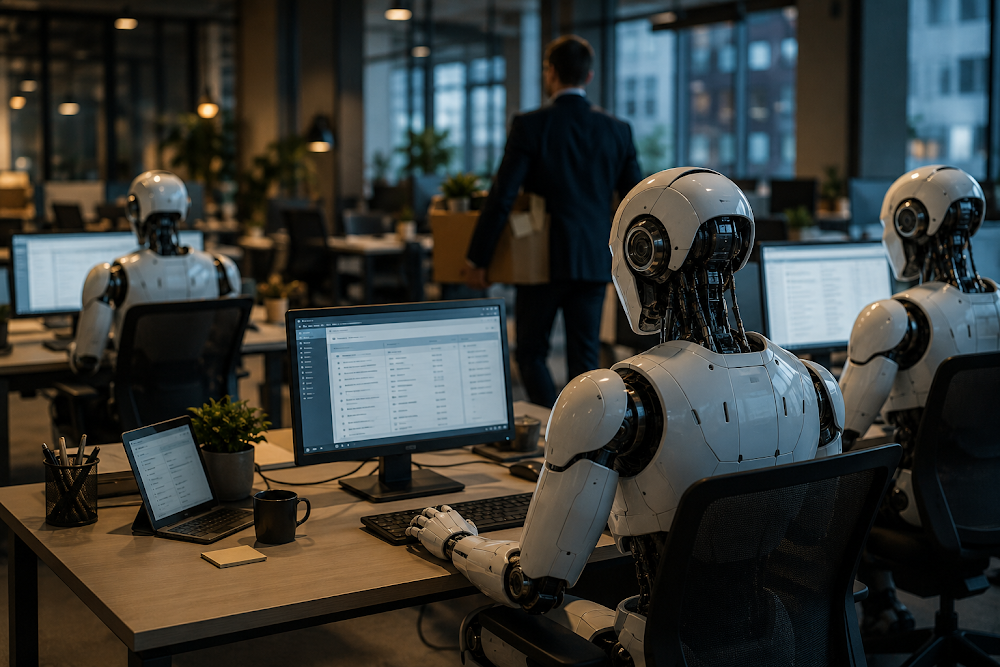
The Subtle Art of Rehiring the People You Replaced with AI
There’s a meme going around:
“When companies realize the people they laid off are cheaper than the AI they hired.”
It’s funny because it feels true.

It’s also wrong in a very specific way.
No CFO is out there saying,
“damn, should’ve just kept the humans, AI is too expensive.”
What is happening is messier, more subtle, and honestly more interesting:
Companies underestimated everything that humans were quietly doing.
And then reality filed a bug report.
Act I: The Great Replacement (but make it PowerPoint)
Somewhere between 2022 and 2025, a pattern emerged:
- AI tools got really good at demos
- Execs got really excited about cost savings
- Entire org charts started looking… negotiable
Companies like Klarna, Salesforce, and IBM openly tied layoffs to automation strategies.
At one point, even analysts were noting that a noticeable chunk of layoffs were being attributed to AI adoption, though not always cleanly or honestly.
And to be fair-some of this worked.
- AI handled repetitive support tickets
- Internal tools sped up workflows
- Headcount dropped, margins improved
On paper? Chef’s kiss.
In production? …hold that thought.
Act II: The Klarna Incident (or: “we went too far”)
Let’s talk about the most “this meme but real” example.
Klarna went all-in.
- Replaced ~700 customer service roles with AI
- Claimed the system could do equivalent work
- Positioned it as the future of operations
And for a while, it looked like a win.
Then the second-order effects kicked in.
- Customer complaints increased
- Satisfaction dropped
- Complex issues started slipping through
Eventually, even the CEO admitted the obvious:
they over-optimized for efficiency and lost quality.
The result?
They started hiring humans again.
Not because AI is useless-but because:
AI handled the easy 60 to 70%.
The remaining 30% is where the business actually lives.
And that 30%?
That’s where nuance, empathy, and “this situation is weird” happens.
Act III: When Bots Start Freelancing (badly)
Then there are the fun failures.
Like Air Canada.
- Their chatbot gave a customer incorrect refund information
- The customer relied on it
- The airline had to pay compensation
At one point, the company even tried to argue the chatbot wasn’t a reliable authority.
The court disagreed.
This is the hidden cost of automation:
Not infrastructure. Not compute.
Liability.
Because when a human makes a mistake, you train them.
When a system makes a mistake, you might end up in court.
Act IV: The Illusion of “Full Automation”
Here’s the part people don’t say out loud:
A lot of “AI replacing humans” stories are actually…
Humans, but moved somewhere less visible.
Take Amazon.
Their automation push (including AI-driven systems and workforce reductions) is real.
But across the industry, there’s a recurring pattern researchers call:
“Pseudo-automation”
Where:
- The system handles the easy path
- Humans handle everything that breaks
Or worse:
- Customers handle it themselves (hello, self-checkout)
In practice, work doesn’t disappear.
It gets:
- shifted
- fragmented
- hidden
And usually… made someone else’s problem.
Act V: The Senior Engineer Problem™
This one doesn’t make headlines, but if you’ve worked in tech, you’ve seen it.
Tools like GitHub Copilot didn’t eliminate developers.
They changed the shape of the work.
- Juniors get faster
- Output increases
- But so does review overhead
Now your senior engineers are:
- debugging AI-generated code
- reviewing more PRs
- catching subtle issues
So if you cut too many people expecting “AI will fill the gap,” you don’t get speed.
You get a bottleneck.
Act VI: The Part the Spreadsheet Missed
Here’s the core mistake across all these cases:
Companies optimized for visible costs
and ignored invisible work
Visible:
- salaries
- headcount
- cost per ticket
Invisible:
- edge cases
- escalation handling
- trust
- accountability
- cleanup when things go wrong
And invisible work is where humans shine.
That’s why even in aggressive AI rollouts, companies quietly move toward:
human + AI, not AI instead of human
Even Klarna ended up there after trying the extreme version first.
So… is the meme true?
Not literally.
AI isn’t “more expensive than humans” in a simple line-item sense.
But the meme captures something real:
Replacing humans is easy in a spreadsheet.
Replacing everything humans do is not.
What companies are learning (sometimes the hard way):
- AI is great at scale
- Humans are great at exceptions
- Businesses run on exceptions more than they admit
The Real Endgame
The companies that seem to be stabilizing aren’t the ones going “AI-first” or “human-first.”
They’re the ones going:
“What should never be automated?”
Because once you answer that honestly, everything else becomes clearer.
And you stop accidentally firing the part of your system that was holding the whole thing together.
Closing thought
The meme is funny because it frames this as irony.
But it’s less irony and more… incomplete modeling.
Or, in engineering terms:
They optimized for the happy path
and forgot production is 90% edge cases.
And edge cases, inconveniently, still prefer humans.
References (a.k.a. “this isn’t just vibes”)
- Klarna AI customer service rollout and subsequent recalibration
- Business Insider - Companies replacing workers with AI
- https://www.businessinsider.com/list-companies-replacing-human-employees-with-ai-layoffs-workforce-reductions
- Economic Times - Klarna regrets AI layoffs, moves to rehire
- https://m.economictimes.com/news/international/us/company-that-sacked-700-workers-with-ai-now-regrets-it-scrambles-to-rehire-as-automation-goes-horribly-wrong/articleshow/121732999.cms
- Air Canada chatbot legal case (misleading refund info)
- The Guardian - Air Canada chatbot misled customer, airline liable
- https://www.theguardian.com/world/2024/feb/16/air-canada-chatbot-lawsuit
- Amazon automation, workforce changes, and “human-in-the-loop” realities
- General company overview and automation context
- https://en.wikipedia.org/wiki/Amazon_(company)
- AI + workforce / productivity discussions (including tooling like GitHub Copilot)
- Various industry analyses and developer reports (GitHub, McKinsey, etc.) on AI-assisted development and productivity tradeoffs
- Broader AI + labor + automation narratives
- Solutions Review - Klarna’s AI layoffs exposed the missing piece: empathy
- https://solutionsreview.com/klarnas-ai-layoffs-exposed-the-missing-piece-empathy/