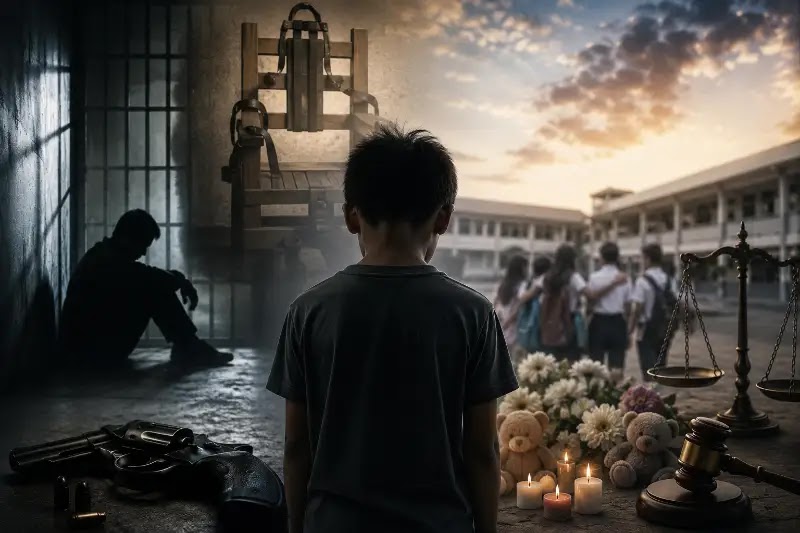
Tacloban School Shooting, Baby Ama, and the Question of Justice: Are We Solving the Right Problem?
The tragic school shooting at San Jose National High School in Tacloban City has, unsurprisingly, shaken the nation.
Three students lost their lives. Many more were injured. Families were left grieving, classmates traumatized, and the entire country doing that very Filipino thing where we act stunned after a disaster that should have been prevented by the kind of basic adult competence we keep treating like a luxury item. According to authorities, the alleged perpetrators were minors aged 14 and 15 years old. Investigations have pointed to possible bullying, while reports also revealed that the firearms used in the attack were obtained from adults who were supposed to be responsible for securing them. Because apparently, in this country, “please keep the guns away from children” still needs to be said out loud.
As emotions run high, a familiar debate has resurfaced: Should the Philippines lower the age of criminal responsibility?
Senator Robin Padilla has renewed his push to amend Republic Act No. 9344, the Juvenile Justice and Welfare Act, lowering the minimum age of criminal responsibility from 15 to 10 years old for minors involved in heinous crimes such as murder, rape, and drug trafficking. Supporters argue that society needs stronger accountability. Critics argue that the proposal punishes children while ignoring the circumstances that lead them into crime. Which, to be fair, is a fairly important detail if the goal is to stop future tragedies instead of just staging another round of tough-guy legislation for the benefit of people who think shouting “discipline” is the same thing as policy. And in a twist that practically writes its own satire, Padilla once portrayed Baby Ama's kid in a film (Anak ni Baby Ama), making his current push feel even more ironic than usual.
At the center of this discussion is a difficult question:
When a child commits an unthinkable act, what kind of justice best protects society?
The Lesson of Baby Ama
As this debate unfolds, many Filipinos have revisited the story of Marcial "Baby" Ama.
Baby Ama remains one of the most controversial figures in Philippine criminal history. He was known as a young offender who spent much of his life inside the prison system and was eventually executed by electric chair in 1961. Historical accounts often note that he was still in his teens when he became entangled in the justice system. A grim reminder that the state has never exactly been known for subtlety when it comes to young offenders.
Whether one views Baby Ama as a criminal, a victim of circumstance, or both, his story reflects a very different era. Juvenile offenders could be placed alongside hardened adult criminals. Rehabilitation programs were limited. The justice system focused heavily on punishment and far less on intervention. In other words, the old system had all the warmth of a cement floor in December, which is apparently the kind of model some people still want to cosplay as “reform.”
Today, Philippine law recognizes that children and adults are not the same.
Modern research in psychology, neuroscience, and criminology has consistently shown that adolescent brains are still developing, particularly in areas involving impulse control, judgment, and long-term decision-making. This understanding helped shape juvenile justice systems around the world, including the Philippines' Juvenile Justice and Welfare Act.
But acknowledging these realities does not erase accountability.
The challenge is determining what accountability should look like, instead of defaulting to the national reflex of demanding punishment first and pretending that counts as a policy. That approach may sound decisive on television, but it tends to collapse the moment anyone asks how it actually prevents the next tragedy.
The Tacloban Tragedy Raises Hard Questions
The facts emerging from Tacloban complicate the public conversation.
The shooting was allegedly committed by minors. Yet minors did not manufacture the firearms. Minors did not legally own the weapons. Investigators found that one firearm was a police-issued Glock while another was linked to a security agency. Authorities are now examining the adults responsible for allowing those weapons to fall into children's hands. A shocking development, apparently, because adults being careless with guns has never once ended in disaster before.
This is precisely the point raised by human rights lawyer Chel Diokno:
"Hindi mangyayari ang trahedya kung hindi nakarating ang mga baril sa kamay ng mga bata. Dapat parusahan ang mga matatandang nagpabaya."
It is a statement that shifts the focus from a simple question of punishment toward a broader question of responsibility.
If children gained access to deadly weapons because adults failed in their duties, should society focus solely on punishing the children?
Or should it also confront the failures of the adults, institutions, and systems that allowed the tragedy to occur? Because if we keep pretending the problem begins and ends with the minors, we are basically choosing the most convenient explanation and calling it justice. That may be politically useful for people who prefer slogans over solutions, but it is not serious governance.
Accountability and Child Protection Are Not Opposites
One misconception often emerges whenever juvenile justice is discussed.
People assume there are only two options:
Either punish children like adults, or excuse their behavior entirely.
In reality, the law already recognizes a middle ground. A radical concept, apparently: nuance.
Children in conflict with the law can undergo intervention, rehabilitation, psychological assessment, supervision, and structured programs designed to prevent reoffending. Serious cases can still result in confinement and court proceedings, but within a framework that acknowledges the developmental differences between children and adults.
The Commission on Human Rights recently emphasized that accountability, child protection, and justice are not mutually exclusive. The organization called for a rights-based response that protects victims while ensuring due process and rehabilitation opportunities for minors involved in the incident.
This distinction matters.
Justice is not only about what happens after a tragedy.
It is also about preventing the next one. A concept so obvious it somehow keeps needing to be rediscovered after every national crisis, especially when some politicians discover that outrage polls better than prevention.
Why Prevention Matters
If investigations ultimately confirm reports of prolonged bullying, access to unsecured firearms, and warning signs that went unaddressed, then the Tacloban tragedy becomes more than a criminal case.
It becomes a systems failure.
A failure of supervision.
A failure of intervention.
A failure of child protection.
A failure of responsible firearm ownership.
Lowering the age of criminal responsibility may satisfy public outrage. It may create a stronger perception of accountability. It may even make some people feel like something decisive has been done, which is often the real goal in these debates.
But it does not automatically answer the deeper question:
Would it have prevented the Tacloban shooting?
Would stricter enforcement of firearm storage laws have prevented it?
Would earlier intervention in bullying cases have prevented it?
Would stronger mental health support have prevented it?
Would better school security have prevented it?
These are difficult questions because they require long-term solutions rather than immediate emotional responses. And long-term solutions, as usual, are far less popular than dramatic punishment proposals that let lawmakers look stern without having to fix the mess adults created in the first place.
Justice Must Protect Both Present and Future Victims
The grief felt by the families of the victims is real.
The demand for accountability is legitimate.
The anger is understandable.
But history teaches us that societies often make their most consequential decisions during moments of pain and fear. Which is exactly why bad policy tends to arrive wearing the costume of urgency and speaking in the voice of “common sense.”
The story of Baby Ama reminds us what happens when justice becomes defined solely by punishment.
The Tacloban tragedy reminds us that children can commit acts with devastating consequences.
Both realities can be true at the same time.
A child who commits a serious crime must face consequences.
But society must also ask how that child reached that point.
Who failed to intervene?
Who allowed access to weapons?
Who ignored warning signs?
Who failed to protect both the victims and the offenders before tragedy occurred?
Real justice does not choose between accountability and prevention.
It demands both.
Because every child lost to violence is a tragedy.
And every child who grows into violence is evidence that something failed long before the crime was committed.
If the nation truly wants to honor the victims of Tacloban, the goal should not simply be to punish after the fact.
The goal should be to build a system where fewer children become victims, fewer children become offenders, and fewer families have to experience this kind of loss ever again. And maybe, just maybe, where lawmakers resist the urge to turn every crisis into a chance to audition for the role of national disciplinarian.
References
- Philippine News Agency. School shooting kills 3 students in Tacloban City. June 2026.
- https://www.pna.gov.ph/articles/1277916
- Philippine News Agency. Follow-up report on the Tacloban school shooting investigation. June 2026.
- https://www.pna.gov.ph/articles/1277941
- Commission on Human Rights. Statement of the Commission on Human Rights on the Tacloban School Shooting Incident. June 23, 2026.
- Inquirer.net. School shooting kills 3 students in Tacloban. June 2026.
- https://newsinfo.inquirer.net/2250793/school-shooting-kills-3-students-in-tacloban
- Reuters. Philippines rethinks school safety after rare shooting kills three. June 23, 2026. Information regarding the suspects' ages, bullying as a possible motive, and the firearms traced to a police-issued Glock and a security-agency revolver.
- Associated Press. High school shooting in the Philippines kills 3, and police arrest 2 students. June 22, 2026. Information regarding casualties, the suspects, and the investigation into firearm access.
- Department of Education Region VIII. Statement on the School Shooting Incident in Tacloban City. June 22, 2026. Information regarding crisis response and psychosocial support efforts.
- Philippine Star. Tacloban school shooting wounded count rises to 20. June 23, 2026. Updated casualty figures and police reports.
- Philippine Star. DepEd calls incident a ‘high-alert situation’. June 23, 2026. Statements regarding national school safety measures and psychosocial interventions.
- Republic Act No. 9344. Juvenile Justice and Welfare Act of 2006. Official Gazette of the Republic of the Philippines.
- https://www.officialgazette.gov.ph/2006/04/28/republic-act-no-9344/
- Republic Act No. 10627. Anti-Bullying Act of 2013. Official Gazette of the Republic of the Philippines.
- https://www.officialgazette.gov.ph/2013/09/12/republic-act-no-10627/
- Senate of the Philippines. Statements and legislative discussions regarding proposals to amend the Juvenile Justice and Welfare Act and lower the minimum age of criminal responsibility. (Various legislative records and public statements, 2026.)
- Historical references on Marcial “Baby” Ama, including Philippine prison history archives, historical newspaper accounts, and biographical discussions documenting his life, incarceration, and execution in 1961.