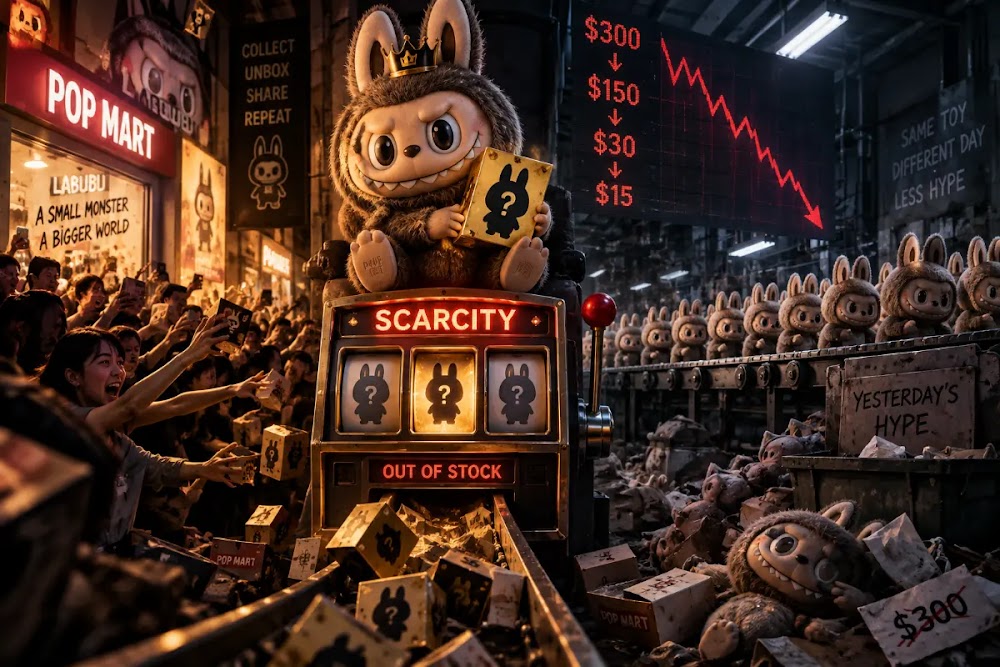

Labubu Didn’t Crash. Pop Mart Just Accidentally Unplugged the Slot Machine
There is something deeply hilarious about capitalism when it accidentally discovers human psychology and then immediately tries to put it into a spreadsheet.
Labubu is a perfect example.
A weird little creature with nine teeth somehow became a global consumer obsession. People lined up for it. People fought over it. People paid hundreds of dollars for tiny plush toys that, under normal circumstances, would probably be sitting beside a claw machine at the mall while somebody's child screams because Dad spent ₱500 trying to win a Pikachu.
Except Labubu wasn't normal.
It became scarce.
And scarcity, as humanity has repeatedly demonstrated throughout history, makes people fucking stupid.
The $30 Toy That Somehow Became a $300 Asset
Nobody was really paying $300 for a plush toy.
They were paying $300 for the fact that getting one was a pain in the ass.
That distinction is basically the entire Labubu story.
Pop Mart understood something that traditional toy companies have been trying to rediscover since forever: people don't necessarily want the object. They want the experience surrounding the object.
The mystery.
The hunt.
The flex.
The dopamine hit.
The ability to post a photo online and quietly communicate, "Yes, I managed to get one of these motherfuckers."
Labubu wasn't just a plush. It became a tiny social-status token wrapped in fur.
And then Pop Mart added blind boxes.
Because apparently gambling wasn't enough. We needed gambling with adorable monsters.
The Blind Box Was Basically a Slot Machine With Better PR
The genius of the blind box is that you don't know what you're buying.
You hand over your money.
You open the box.
Maybe you get the thing you want.
Maybe you get the thing you don't want.
Maybe you get a duplicate.
Maybe, if the collectible gods are feeling particularly charitable, you get one of the rare secret editions.
And suddenly your brain isn't thinking, "Do I need another toy?"
It's thinking:
"What if the next one is the rare one?"
Congratulations. You are no longer shopping.
You are participating in a tiny furry casino.
The important part is that losing doesn't necessarily feel like losing.
If you get the wrong character, you can buy another box.
If you get another duplicate, surely the next one will be different.
And if you finally get the rare one, congratulations. Your brain has just received its little fireworks display.
This is variable reward mechanics, the same broad psychological principle that makes slot machines, loot boxes, and other randomized reward systems so effective at encouraging repeated behavior.
Except now the slot machine has a cute face.

Then TikTok Did What TikTok Does
The next ingredient was visibility.
Someone opens a blind box.
They film it.
They upload it.
Someone else watches.
They see the rare figure.
They want one.
They buy one.
They film themselves opening it.
The next person watches.
And suddenly the internet has created an infinite conveyor belt of people advertising the product to each other for free.
Celebrity exposure poured gasoline onto it.
When Lisa from BLACKPINK was photographed with Labubu, the thing went from collectible to cultural infection.
Now everybody knew what the weird little gremlin was.
And once everybody knows something is difficult to get, the brain does the stupid little thing it has been doing since humans started hoarding shiny rocks.
"I need that."
Not because they need it.
Because somebody else has it.
The Resale Market Was Where Things Got Really Weird
Then came the scalpers.
And this is where the toy stopped behaving like a toy.
A Labubu that cost around $30 could suddenly trade for $70, $100, $300, or substantially more depending on the character, edition, timing, and market.
The secondary market effectively told consumers:
This thing is not just something you bought. It might be worth more later.
That changed the psychology completely.
You weren't simply buying a plush anymore.
You were buying something with an apparent future value.
And technically, Pop Mart didn't even need to create that value directly.
The resale market did it for them.
Every time somebody sold a Labubu for three times retail, everyone else watching learned the same lesson:
Holy shit. These things are valuable.
Which encouraged more people to buy.
Which increased demand.
Which made rare versions harder to find.
Which pushed resale prices higher.
Which attracted more people.
And now we have the beautiful economic machine known as:
"Wait, maybe I can make money from this stupid little creature."
And Then Pop Mart Looked at the Golden Goose
At some point, Pop Mart had a problem.
People wanted Labubu.
Unfortunately, there weren't enough Labubus.
From the perspective of a normal company, this is fantastic news.
You have demand.
You have customers.
You have people willing to pay stupid amounts of money.
So naturally the answer is:
MAKE MORE FUCKING LABUBUS.
And that's exactly where the machine started eating itself.
Production reportedly exploded from hundreds of thousands of plush units per month to tens of millions.
From a traditional manufacturing perspective, this makes perfect sense.
There is demand.
Increase supply.
Sell more units.
Capture revenue that previously went to scalpers.
Make shareholders happy.
Everybody gets a Labubu.
Everybody wins.
Except there was one tiny problem.
The shortage was part of the product.
You Can't Manufacture Scarcity by Manufacturing Everything
This is the part where the spreadsheet walks into the room wearing a suit and gets everyone killed.
Pop Mart could manufacture the physical object.
What it couldn't manufacture at the same scale was the feeling that the object was difficult to obtain.
Once Labubu became easy to find, the psychological equation changed.
Before:
"Holy shit, they have one."
After:
"Oh. They're everywhere."
That tiny change is devastating.
Because scarcity wasn't merely a supply problem.
Scarcity was marketing.
Scarcity was status.
Scarcity was content.
Scarcity was resale value.
Scarcity was the reason somebody cared.
You can make 30 million plush toys.
You cannot make 30 million people feel like they're hunting for something rare.
That's not how this works.
The Scalpers Didn't Save the Market
And then the resale market did what markets usually do when everyone realizes the party is over.
It dumped.
If people were previously paying $300 because the item was difficult to obtain, what happens when the item becomes readily available?
The $300 price starts looking fucking ridiculous.
Then $200 looks ridiculous.
Then $100.
Then eventually somebody looks at the retail price and says:
"Why would I pay more second-hand than I can pay in the store?"
Congratulations.
The arbitrage opportunity has been murdered.
And once the resale premium disappears, the scalper's incentive disappears with it.
So they sell.
That pushes prices lower.
Lower prices encourage more selling.
More selling pushes prices lower.
Suddenly the people who were treating Labubu like a tiny furry Bitcoin are holding warehouses full of plushies that nobody particularly cares about anymore.
That's not a crash.
That's a group project where everyone simultaneously realizes the presentation is tomorrow and nobody did the slides.
The Weirdest Part: Pop Mart Was Still Making Money
And here's where the story gets really interesting.
The business didn't immediately collapse.
Revenue kept growing.
Massively.
That's because physical sales can remain strong even while the underlying hype is weakening.
If you flood the market with product, you can sell a tremendous amount of product.
The revenue numbers will look beautiful.
The dashboards will turn green.
Someone in a meeting will say:
"Great quarter, everyone."
Meanwhile, the thing that made the numbers possible is slowly dying in the background.
This is one of the most dangerous things about looking at business through historical financial metrics.
Revenue tells you what happened.
It doesn't necessarily tell you what people are going to want next.
The spreadsheet is a rear-view mirror.
Unfortunately, corporate strategy often treats it like a windshield.
Then the Internet Stopped Caring
By 2026, search interest for Labubu had reportedly fallen dramatically from its peak.
Resale prices had collapsed on many models.
Some editions were selling below retail.
The stock had fallen heavily from its peak.
And then came one of the funniest signals of all.
Pop Mart announced record financial results.
Revenue was up enormously.
Profit was up even more.
And the market responded by selling the stock.
Imagine spending months preparing a PowerPoint explaining how fucking incredible your company's numbers are, only for investors to respond:
"Yes. We saw the numbers. That's exactly why we're leaving."
Because investors weren't necessarily asking whether Pop Mart made money.
They were asking a different question.
How much of this growth is sustainable after the fever breaks?
That is a much scarier question.
Because the Product Was Never Really the Plush
The genius of Labubu was never manufacturing.
A plush toy is not particularly difficult to manufacture.
China has been manufacturing physical objects at industrial scale for decades.
The valuable part was the desire.
That's what Pop Mart managed to export.
And this is where the Labubu story becomes much bigger than a toy.
For decades, the simplistic global narrative was:
The West designs.
China manufactures.
The Western brand captures the premium.
China gets paid to make the thing.
Pop Mart demonstrated another possibility.
A Chinese company could own the character, own the retail experience, build the brand, create the demand, and sell the finished emotional product directly to consumers in New York, London, Paris, Singapore, Manila, and everywhere else.
That's fucking significant.
A company from China wasn't merely making something cheaper.
It was convincing people overseas to want something.
Badly.
And the Margins Were Saying the Quiet Part Out Loud
Pop Mart's reported gross margin reached luxury-brand territory.
That's insane for a toy company.
Because the manufacturing cost of a little plush monster isn't what you're really paying for.
You're paying for the character.
The packaging.
The mystery.
The community.
The status.
The possibility that your particular stupid little monster might be worth more than the one sitting beside it.
A product can cost $5 to manufacture and sell for $30 because the remaining $25 isn't paying for plastic, fabric, stuffing, or labor.
It's paying for meaning.
That's basically what luxury has been doing forever.
A handbag isn't expensive because leather suddenly became gold.
A sneaker isn't expensive because rubber discovered inflation.
The consumer is paying for the story.
Pop Mart figured out how to do that with a creature that looks like it was designed by somebody who hadn't slept since Tuesday.
Then the Lafufus Arrived
As if oversupply wasn't enough, counterfeit Labubus began flooding marketplaces.
The internet gave them an appropriately cursed name:
Lafufu.
Honestly, humanity deserves credit for that one.
But the joke hides a serious problem.
Counterfeits are particularly damaging to products whose value depends heavily on authenticity.
If a generic plush is fake, whatever.
If the entire point of your collectible is that it's rare, authentic, desirable, and socially recognizable, then suddenly seeing mountains of suspiciously cheap knockoffs creates a different psychological reaction.
"Is mine real?"
"Is that one fake?"
"Why are there 400 of these?"
"Wait, are these even rare anymore?"
That's poison for a scarcity-driven collectible.
The more the market becomes saturated with things that look like Labubu, the less special owning one feels.
Pop Mart Now Has to Turn a Toy Into a Universe
And this is where the next chapter gets interesting.
Because Pop Mart can't rely forever on people fighting over plushies.
Eventually you have to answer the question:
What happens when the hype ends?
The obvious answer is to build a universe.
Disney did it.
Pokémon did it.
Sanrio did it.
Marvel did it.
Characters can survive for decades if you build stories, worlds, merchandise, experiences, media, and communities around them.
So Pop Mart is pushing Labubu toward movies, theme parks, jewelry, collaborations, and broader entertainment.
At that point, Labubu stops being a plush toy.
It becomes intellectual property.
And that is potentially a much bigger business.
The problem is that Mickey Mouse wasn't created by a blind box.
People didn't spend their childhoods watching a weekly episode of The Adventures of Labubu and His Financially Irresponsible Friends.
That's the experiment.
Can a character born from scarcity and collectible mechanics become something people love independently of scarcity?
That's much harder.
The Real Question Isn't Whether Labubu Is Dead
I don't think the interesting question is whether Labubu is "dead."
That's internet-brain thinking.
A thing becomes slightly less popular and suddenly somebody makes a YouTube thumbnail with a red arrow pointing downward and the word DEAD?!
Pop Mart is still a huge company.
It's still generating billions in revenue.
It has international stores, multiple characters, enormous distribution, and a business model that clearly works beyond one plush monster.
The interesting question is something else.
What remains when the artificial urgency disappears?
If people buy Labubu because they genuinely love Labubu, then the brand can survive.
If people bought Labubu because everyone else wanted Labubu, then the moment everyone stops caring becomes catastrophic.
That's the difference between a brand and a bubble.
One survives when the crowd leaves.
The other discovers that it was the crowd.
The Beautifully Stupid Lesson of Labubu
There is a fantastic irony buried inside all of this.
Pop Mart proved that desire can be manufactured.
Then it may have accidentally proven that manufactured desire has limits.
The company successfully created scarcity.
The scarcity created demand.
The demand created resale value.
The resale value created more demand.
The demand attracted more people.
More people created more hype.
Then Pop Mart produced enough product to satisfy everyone.
And by satisfying everyone, it potentially destroyed one of the reasons everyone wanted it.
It's almost poetic.
In the most capitalist way possible.
"We should give customers what they want."
Customer:
"I want the rare thing."
Company:
"Okay, here's 30 million of them."
Customer:
"...not like that."
You Can't Spreadsheet Your Way Out of Human Psychology
This is the bigger lesson.
Businesses love measurable things.
Units sold.
Revenue.
Margins.
Production capacity.
Store count.
Inventory.
Conversion rate.
All of those things matter.
But desire is weird.
People don't always want things because they're available.
Sometimes they want them because they're unavailable.
Sometimes the inconvenience is part of the experience.
Sometimes the frustration creates the value.
Sometimes making something easier to buy makes people less interested in buying it.
And that's the uncomfortable part for any company trying to manufacture culture.
You can manufacture the object.
You can manufacture the packaging.
You can manufacture the supply chain.
You can manufacture the advertising.
You can manufacture the scarcity.
But eventually, somebody has to actually give a shit.
That's the part no spreadsheet can guarantee.
So What Happens to the Little Bastard?
Maybe Labubu becomes a permanent character.
Maybe the movie works.
Maybe the theme parks work.
Maybe Molly, Crybaby, Twinkle Twinkle, and the rest of the Pop Mart family become the next generation of global characters.
Or maybe five years from now somebody finds a dusty Labubu sitting in a drawer and says:
"Holy shit, remember when these were worth $300?"
That's the fascinating part.
Pop Mart already proved it could make the world want a Chinese character.
Now it has to prove something considerably harder:
Can it make people want the character after they no longer need to chase it?
Because manufacturing a shortage is one thing.
Manufacturing love is another.
And if there's one thing capitalism has taught us, it's that the moment somebody figures out how to manufacture love, there will immediately be a quarterly earnings target attached to it.
Good luck, little nine-toothed bastard.
You're going to need it.