
There is a special kind of email that immediately makes you question your own memory.
Not because it's personalized. Not because someone knows your work. Not because a recruiter mentions your portfolio, your GitHub, your years of experience, or some project you built.
No.
This one started with:
Hi ,
And then proceeded to inform me that my job application was moving forward.
The only problem?
I never fucking applied.
Welcome back to the Rabbit Hole Files.
Apparently, I have now developed a recurring hobby of investigating recruitment operations that somehow manage to find their way into my inbox despite me having absolutely no memory of asking them to.
The first time was Crate App.
The second time was Umicas.net, which turned out to be less of a job platform and more of an advertising and behavioral-tracking rabbit hole dressed up like one.
Now it's SourceHire.
And this one is different.
Because this time, I wasn't even looking for a job.
Previously, on “Why the Fuck Is This In My Inbox?”
If you've read my earlier posts, you already know the pattern.
In 2025, I wrote about an unsolicited recruitment email from something calling itself Crate App. I hadn't applied, the company was difficult to verify, and the emails became increasingly suspicious. I documented the emails, searched for the company, compared the messages, and eventually found other people reporting similar experiences.
That investigation eventually led somewhere more interesting.
The supposedly innocent job links were redirecting people toward Umicas.net.
So I dug further.
What looked like recruitment pages contained advertising infrastructure, tracking scripts, and a collection of things that made the experience feel much more like an ad-monetization operation than an actual hiring pipeline. I documented the technical side of that investigation separately, including what other people were reporting.
At the time, I thought that was probably the end of it.
Apparently the internet had other plans.
August 26, 2026: “Thanks for Applying”
On August 26, 2026, an email landed in my inbox from:
The subject was essentially:
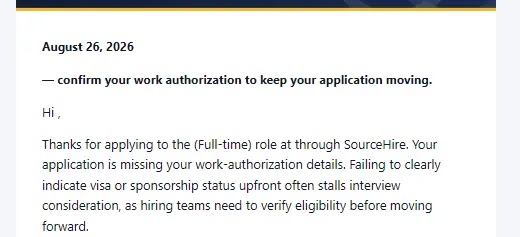
Confirm your work authorization to keep your application moving.
That sounds normal enough.
Until you remember one small detail.
I never applied.
The email claimed I had applied through SourceHire and that my application was being considered for an interview.
It also claimed that my resume and details were already saved.
There was just one tiny problem with that claim.
I didn't give them a fucking resume.
And they couldn't even retrieve my first name.
The greeting was literally:
Hi ,

Apparently my resume is already safely stored in their recruitment system, my application is progressing, and the hiring team is considering me.
But my first name?
Gone.
Lost somewhere between the database and the email template.
The First Email Was Broken
The first message didn't even properly populate the job information.
It effectively said:
“Thanks for applying to the (Full-time) role at through SourceHire.”
That's not a typo.
That's a recruiting template having a small existential crisis.
The job title wasn't there.
The company wasn't there.
My name wasn't there.
The recruiter wasn't there.
There was no explanation of when I supposedly applied.
There was no useful job description in the body.
Just:
You applied. Your application is moving. Your work authorization is missing. Click this thing.
Naturally, I didn't.
And that distinction matters.
A recruiter discovering your public LinkedIn profile and contacting you is normal.
A recruiter saying:
“Hey, I found your profile and think you'd be a great fit.”
is completely different from:
“Thanks for applying.”
The second statement asserts that an application exists.
Then Email Number Two Arrived
The second email was much more complete.
It identified the position as:
Senior Software Engineer II
at:
TEK Systems
It even included:
Reference REQ84801
Now we're getting somewhere.
Except I still didn't fucking apply.
The email repeated the same pitch:
“Your application is being considered for an interview for this position.”
And then:
“your resume and details are already saved.”
Again:
No. They weren't.
At least, not because I had submitted them.

This is where I started paying attention to the wording.
Because there is a very important difference between:
“We found your profile.”
and:
“You applied.”
The first is unsolicited recruiting.
The second creates a history that, as far as I know, never happened.
So I Started Looking
This is where the story became familiar.
Very familiar.
I searched for SourceHire.
I searched for the companies appearing on SourceHire.
I searched Reddit.
I searched LinkedIn.
I searched the job references.
I searched the address.
And, because apparently I have nothing better to do with my evening, I started reading people's experiences with the platform.
That's when the rabbit hole opened.
The Reddit Rabbit Hole
One Reddit post from July 2026 described an almost absurdly similar SourceHire workflow.
The poster had been looking for executive-level roles and encountered LinkedIn listings associated with Integral Creative Solutions (ICS).
The jobs redirected applicants to SourceHire.
The applicant uploaded a CV and other information.
Then came the interesting part.
SourceHire displayed a live ATS-style ranking.
The poster reported seeing a message indicating they ranked above a percentage of applicants and then being offered the ability to pay $15 to prioritize the application.
They didn't pay.
Instead, they started investigating.
The Reddit investigation: “Integral Creative Solutions Search Firm a Scam?”
The thread is particularly interesting because it doesn't consist of one person saying “this feels weird.”
It contains multiple people comparing experiences.
One commenter said SourceHire showed 115 jobs, with 96 attributed to Integral Creative Solutions, and questioned how a supposedly retained executive-search firm could suddenly have such a massive collection of unrelated positions.
The same commenter also reported seeing wildly different roles, enormous compensation ranges, and even a posting with a salary typo of $350,000 to $5,000,000.
Those are allegations from a Reddit investigation, not facts I independently verified.
But they're worth documenting because they're part of the pattern other applicants were seeing.
And this wasn't some ancient post dug out of the internet.
It was July 2026.
The Strange Economics of “Priority Review”
This is where things get particularly interesting.
SourceHire itself currently documents a feature called Priority Review. Its current page describes it as a paid visibility feature that places an application on a separate sponsored shortlist for the hiring team. It says applicants must already be above the 30th percentile to qualify, that the hiring team is told the application was sponsored, and that the payment does not change the candidate's underlying merit score. SourceHire — Priority Review
So the “pay for priority” mechanism isn't something Reddit invented.
SourceHire itself documents it.
And there's an interesting wrinkle here.
Another SourceHire help page still describes Priority Review as a monthly subscription, while the current dedicated Priority Review page says the feature is now a one-time, non-refundable fee. A separate pricing page still describes a monthly price of $12/month. SourceHire — Help Center
That inconsistency is worth showing rather than hiding.


And while we're looking at these screenshots, I have another question:
WHAT THE FUCK IS THAT TEXT COLOR?
Seriously.
Look at the second screenshot.
Some of that text is sitting on a white background with such weak contrast that I genuinely had to squint at the screen to figure out what I was reading.
This isn't me making some grand accessibility lawsuit out of a recruiting website. It's just fucking bad UI.
If you're asking people to understand how your paid candidate-prioritization system works, the explanation should probably be readable without requiring the user to enter a medically supervised eye exam.
More importantly, poor contrast makes the documentation harder to independently verify. When the page is already explaining something as consequential as paying to increase an application's visibility, hiding important text behind barely readable styling isn't exactly helping.
Again, none of this proves fraud.
The inconsistent pricing documentation doesn't prove fraud. Poor color contrast doesn't prove fraud. A redesigned pricing model doesn't prove fraud.
But they are still things a prospective applicant should be able to see and evaluate.
And when you're already dealing with a platform that has generated questions about unsolicited applications, candidate data collection, work-authorization requests, and paid application prioritization, small inconsistencies become much more interesting than they would be on an ordinary SaaS landing page.
At minimum, I'd want SourceHire to make its pricing and Priority Review documentation consistent.
And maybe turn the fucking text from #ffffff-ish-on-white into something a human being can actually read.
Other People Were Seeing the Same Thing
Independent reports make this more interesting.
Gabrielle Turmelle published a post in August titled:
“There is no such thing as paying to get your resume prioritized.”
Her post went considerably further than I am willing to go in a definitive sense, calling SourceHire a scam organization and alleging that the Priority Review system was essentially a way to collect payment and data. (Gabrielle Turmelle, MBA)
I wouldn't present her conclusion as independently proven.
But I would absolutely present her experience.
Because that's what this investigation is about.
Different people are encountering the same platform and coming away with the same basic question:
What exactly is the applicant supposed to be buying here?
The ATS Score Rabbit Hole
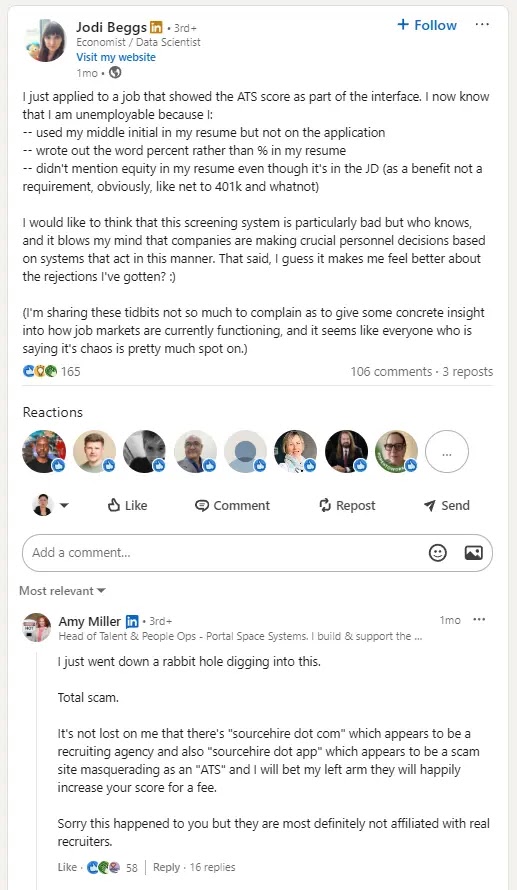
Another interesting piece of this came from Jodi Beggs.
She posted about applying to a job where the ATS score was visible as part of the application interface.
Her experience was almost comically granular: the system apparently cared about discrepancies such as using a middle initial in one place but not another, writing “percent” instead of %, and failing to mention equity in a job description where equity was merely listed as a benefit.
She questioned the wisdom of using such systems to make personnel decisions.
Then the comments got interesting.
One commenter said:
“You just applied to a fake job scam portal.”
Another commenter said they had investigated the site and believed SourceHire was a fake job portal.
Those comments are opinions, not proof.
But again, they're independent people encountering the same system and asking the same uncomfortable questions. (LinkedIn)
Then There Was the Work Authorization Pattern
This part caught my attention because it overlaps directly with the emails I received.
One person responding to the SourceHire discussion described repeatedly being asked for work-authorization details.
That is remarkably close to what appeared in my own emails.
And that's important because work authorization is an excellent piece of social engineering.
You don't have to tell someone:
“Give me your identity.”
You tell them:
“We're missing one thing from your application.”
Suddenly the person isn't being asked to hand information to a stranger.
They're being asked to complete a process they already believe they started.
That's psychologically very different.
Then I Looked at SourceHire's Own Data Practices
This is where the investigation stopped being merely about suspicious emails.
Because SourceHire isn't just a job board.
Its own documentation describes a system that collects and processes candidate information.
The current privacy policy says SourceHire collects information candidates submit when applying and can process resumes and other application information, including structured profile data. It also describes different controller/processor roles depending on whether the candidate applies to a specific employer or joins the broader talent network. (SourceHire)
Its consent page is even more explicit.
SourceHire says that applying involves 10 consents: two required and eight optional.
The required processing includes storing the resume and allowing SourceHire to generate a structured profile for hiring review. (SourceHire)
That matters.
Because a resume isn't just a PDF.
It's your employment history.
Your skills.
Your education.
Your location.
Your career trajectory.
Your salary expectations.
Your contact information.
Potentially your work authorization.
Potentially information that can be derived from all of the above.
And now we're back to my original question:
Why does SourceHire have an application for me when I never applied?
The Advertising Consent Part
The Reddit investigation also surfaced another interesting section of SourceHire's consent system.
One applicant quoted an optional consent relating to personalized advertising and sharing profile information with advertising exchanges and talent-related ad networks.
SourceHire's current legal documentation has since become more explicit about its consent model and says data-partner transfers require affirmative consent to a named partner. Its current Data Partners page says the roster of active third-party partners is publicly maintained. (SourceHire)
Again, I don't want to overstate this.
Optional advertising consent is not itself evidence of fraud.
Recruitment platforms can have legitimate reasons to operate talent networks and advertising systems.
But when you're investigating a platform that is already sending you emails claiming you applied for jobs you don't remember applying for, the question becomes:
What exactly happens to the information when someone actually does apply?
That's a legitimate question.
And Then I Found the Legal Documents
This is one of the strongest findings because it doesn't rely on Reddit.
It comes directly from SourceHire.
Go look at the current Privacy Policy.
Under “Who We Are,” the document says:
“[ENTITY NAME]”
and:
“[STATE OF FORMATION]”
and:
“[BUSINESS ADDRESS]”
Those are not my annotations.
They're literally still in the published document. (SourceHire)

And yes, before anyone asks: I had to fucking highlight the text just to read it.
The text is so light against the white background that it was practically invisible to me until I selected it. I've marked the affected area in the screenshot above. If your legal documentation requires users to highlight the text before they can read what you're telling them about their data, maybe fix the fucking text color.
And it isn't isolated to the Privacy Policy.
The current Data Processing Addendum also identifies the processor as:
“[ENTITY NAME] doing business as SourceHire”
and again contains unfinished corporate-identification language. (SourceHire)

This is the kind of thing that makes me stop and stare at my monitor.
Because we're not talking about a personal blog.
We're talking about legal documentation governing a platform that processes job applicants' personal data.
But the Address Is Real
Now here's where things get more interesting.
The email footer gave me:
2295 Latham Street
Mountain View, CA 94040
So, naturally, I looked it up.
2295 Latham Street, Mountain View, CA 94040 — Google Maps
The address is real.
And SourceHire itself currently publishes it.
Its employer profile identifies SourceHire / Integral Creative Solutions at 2295 Latham Street, Mountain View, and lists the organization as having 1–10 employees.
The profile also makes a very specific claim:
“All Jobs are open and valid and we are activerly recruiting for them.”
Yes.
“activerly.”
That's how it is currently written.

And then there's another little detail that made me stop and go:
Wait. What the fuck is this?
The profile suddenly switches languages.
Right underneath the English company information, the page contains:
Faire Vergütung
Faire Bezahlung und attraktive Konditionen
Onboarding
Strukturierter Start von Tag eins an
Kollegiales Team
Wertschätzung und offenes Miteinander
Zukunftsperspektive
Sicherer Arbeitsplatz mit Perspektive
For those of us who don't speak German: we're suddenly looking at German-language sections describing things like fair compensation, onboarding, a collaborative team, and future career prospects.
And the rest of the profile?
English.
The company description is English.
The address is English.
The job information is English.
The “1–10 employees” information is English.
Then, apparently, Germany has entered the fucking chat.
Now, to be fair, there is a perfectly innocent explanation for this.

It could simply be an unfinished localization template.
It could be boilerplate accidentally left in the page.
It could be a translation system behaving strangely.
It could be some third-party employer-profile software injecting localized content based on a template or account configuration.
I don't know.
And that's precisely why I'm showing it rather than pretending I know what happened.
But when I'm investigating a recruitment platform, and I find an employer profile that contains:
a company claiming to be actively recruiting for all its listed jobs,
an address that matches the address in my unsolicited email,
a claimed company size of 1–10 employees,
a typo in the sentence assuring candidates that the jobs are legitimate,
and suddenly a bunch of unexplained German-language recruitment boilerplate,
I'm going to fucking screenshot it.
Because at some point the page stops looking like something that was carefully reviewed by a recruitment company and starts looking like someone assembled a template, forgot to clean it up, and hit publish.
Again, none of this proves fraud.
A typo isn't fraud. German text isn't fraud. A 1–10 employee company isn't fraud. A real address isn't fraud.
But these details matter when you're evaluating whether you should hand a platform your resume, employment history, work authorization information, salary expectations, and other personal data.
And there's one more thing I find particularly interesting:
The profile doesn't merely identify SourceHire as an employer.
It explicitly tells applicants:
“Apply to all jobs here: https://sourcehire.app/jobs”
So this isn't just some random directory entry containing an old address.
It's an active recruitment funnel pointing candidates directly back into SourceHire.
That makes the quality and consistency of the profile a little more important.
Because if you're going to tell job seekers:
“All Jobs are open and valid.”
you might want to spell “actively” correctly first.
And maybe decide whether your company is recruiting in English, German, or whatever the fuck language the template felt like using that morning.
Then I Looked at the Jobs
And this is where the numbers start getting weird.
SourceHire's public listings currently include positions such as:
President, Executive Operations
with a listed compensation range of:
$475,000–$625,000 per year
and:
President of Global Business Units
with a listed compensation range of:
€450,000–€650,000 per hour
Yes.
Per hour.
Maybe that's a typo.
Maybe it's a spectacularly generous employer.
Maybe somebody accidentally selected the wrong unit.
Either way, if you're building a system where people are expected to trust the job listings enough to upload their resumes, those are the kinds of things that deserve scrutiny. (SourceHire)

And this is important:
I'm not saying a weird salary field proves a job is fake.
I'm saying it is another data point.
That's what an investigation is supposed to do.
Collect the weird shit.
Then see whether the weird shit forms a pattern.
SourceHire Says It's a Consent-First ATS
And to be fair, SourceHire has a lot of documentation defending its model.
The site describes itself as a “consent-first ATS.”
Its Trust Center claims SOC 2 Type II auditing, encryption, access controls, GDPR/CCPA compliance, and other security measures. (SourceHire)
Its legal center has versioned Terms, Privacy, Cookie, Acceptable Use, Arbitration, Data Processing, and Data Partner documentation. (SourceHire)
Its Priority Review documentation explicitly says sponsored status is disclosed to employers and that the system doesn't change a candidate's underlying merit score. (SourceHire)
So no, this isn't a website with absolutely no documentation.
In fact, there's a lot of documentation.
And that's precisely why the unfinished legal placeholders stand out so much.
If you're going to publish a massive collection of privacy policies, consent ledgers, data-processing agreements, security claims, and candidate rights documentation, having [ENTITY NAME] sitting inside the actual legal text is... not ideal.

This Is Where It Connects Back to Umicas
And this is why I'm writing this as part of the same series.
With Crate App, the initial red flag was the unsolicited job email.
With Umicas, the investigation eventually revealed a deeper layer: the fake-looking recruitment experience appeared to involve advertising and behavioral-tracking infrastructure rather than simply functioning as a normal hiring pipeline.
SourceHire feels different.
This isn't primarily about clicking a fake job page and discovering ads.
The suspicious part here is the recruitment workflow itself.
The resume.
The candidate profile.
The ATS score.
The work authorization.
The supposed application.
The paid priority mechanism.
The consent layer.
The recruitment emails.
The candidate data.
And potentially the monetization of the entire funnel.
It's a different rabbit hole.
But it's the same fucking lesson.
The job listing is not necessarily the product.
Sometimes the applicant is.
And That's the Part That Actually Scares Me
I've worked in tech for years.
I know what a normal ATS looks like.
I know how recruitment automation works.
I know how templating systems fail.
I know how tracking links work.
I know what application IDs look like.
I know how easy it is to scrape public information.
And I still had to stop and think:
Wait. Did I actually apply for this?
That's the psychological trick.
The message doesn't need to say:
“Give us your identity.”
It says:
“We're just missing one little thing from your application.”
That's much more believable.
You don't feel like you're giving information to a stranger.
You feel like you're finishing something you already started.
Except you never started it.
The Biggest Red Flag Wasn't the AI Writing
I initially thought the broken grammar and strange formatting were the giveaway.
The first email had missing fields.
My name was absent.
The company and job title were missing.
Some sentences read like a recruiting template that got shoved through a database with half the variables missing.
But that's actually not the most important evidence.
The biggest red flag was:
I never applied.
Everything else came afterward.
Then I found other people describing the same ecosystem.
Then I found the Priority Review documentation.
Then the legal documents.
Then the unfinished entity fields.
Then the public employer profile.
Then the job listings.
And suddenly the question wasn't:
“Is this email weird?”
It was:
“What the fuck is this recruitment system actually doing?”
So What Do I Think?
Here's where I'm going to deliberately avoid the dramatic internet version of this article.
I cannot prove from these findings alone that every SourceHire listing is fraudulent.
I cannot prove that every company using SourceHire is fake.
I cannot prove that SourceHire is committing criminal fraud.
And I don't think pretending otherwise makes the investigation stronger.
What I can say is that I received unsolicited emails claiming I had applied for a job I did not apply for, using a recruitment platform whose public documentation contains contradictory Priority Review descriptions, whose legal documents still contain obvious corporate-identity placeholders, whose public job ecosystem has generated multiple independent complaints and investigations, and whose own platform explicitly collects substantial candidate information.
That's enough for me.
I wouldn't upload my resume there.
And I definitely wouldn't click a link telling me to “confirm my work authorization” for an application I never fucking submitted.
What Job Seekers Should Do
If you receive an unsolicited recruitment email claiming:
“Thanks for applying.”
and you know you didn't apply:
Stop.
Don't click the work-authorization link.
Don't upload another resume.
Don't provide your passport.
Don't provide your visa number.
Don't provide your government ID.
Don't enter your date of birth.
Don't provide banking information.
Don't pay for “priority review.”
Don't assume that because the email came from a real-looking domain, the underlying recruitment process is legitimate.
Instead, independently locate the company's official website, find the job yourself, verify that the position actually exists, and contact the company through a separate channel if necessary.
And most importantly:
Don't let the email create a false sense of urgency.
You don't owe a stranger your employment history because their template says you're already in an interview pipeline.
The Rabbit Hole Is Still Open
The funny thing about these investigations is that they rarely end with:
“Yep, that's the scam. Case closed.”
Instead, you find another person.
Then another.
Then a Reddit post.
Then a LinkedIn comment.
Then a Facebook post.
Then a domain.
Then an address.
Then a legal document with [ENTITY NAME] still sitting in it.
Then a job board with six-figure compensation.
Then an ATS that wants money from applicants.
Then an email telling you that you applied for a job you never applied for.
And suddenly you're sitting there at 1 AM thinking:
What the fuck is going on with the job market?
From Crate App to SourceHire
Looking back, there's a pretty obvious progression.
Crate App taught me that an unsolicited job offer can be the bait.
Umicas taught me that the job page itself can be the trap.
SourceHire is teaching me something slightly different:
The application process can become the business model.
Maybe the goal is data.
Maybe it's paid candidate visibility.
Maybe it's lead generation.
Maybe it's recruitment marketing.
Maybe different actors are responsible for different parts.
Maybe some of the jobs are legitimate and some aren't.
There are still questions I can't answer.
And I'm not going to pretend otherwise.
But there is enough evidence from independent job seekers, Reddit investigations, LinkedIn professionals, SourceHire's own documentation, the platform's own public job listings, and my own unsolicited emails to say one thing confidently:
I wouldn't trust this platform with my resume.
And I definitely wouldn't click a link telling me to “confirm my work authorization” for an application I never fucking submitted.
One More Thing
If you received one of these emails too, don't assume you're alone.
That's probably the most important thing I learned from the Crate App investigation.
The first email always feels personal because it's sitting in your inbox.
Then you search.
And suddenly you find twenty other people saying:
“Wait. I got this too.”
That's when a weird email stops being an isolated annoyance.
It becomes a pattern.
And patterns are where the interesting stuff starts.
Previous Investigations
The Rabbit Hole Files
Crate App Careers Recruitment Scam: How I Was Targeted as a Tech Worker
Crate App Scam Follow-Up: Umicas.net Exposed as Ad Fraud Trap Targeting Tech Workers
Sources & Further Reading
SourceHire — Consent Documentation
SourceHire — Data Processing Addendum
SourceHire — Public Job Listings
SourceHire / Integral Creative Solutions employer profile
Reddit — “Integral Creative Solutions Search Firm a Scam?”
Gabrielle Turmelle — “There is no such thing as paying to get your resume prioritized”
Jodi Beggs — ATS screening / SourceHire discussion
Chad Anctil's post
Google Maps — 2295 Latham Street, Mountain View, CA 94040
Final Thought
Last year, I thought the weirdest thing about recruitment scams was getting contacted by companies I'd never heard of.
Now I think the weirder part is this:
Somewhere in somebody's database, apparently I applied for a job I never fucking applied for.
Apparently my resume and details are already there.
Apparently I'm being considered for an interview.
Apparently they just need me to confirm my work authorization.
Apparently I can even pay to make myself more visible.
And apparently they still don't know my fucking name.
Good luck with that.