We're Patching Holes While the Hull Is Breaking
Not even a week after the Tacloban school shooting, the conversation has already drifted toward something painfully familiar.
Ban violent video games.
Again.
The Department of the Interior and Local Government is now urging Congress to study restrictions on violent games, with titles like GoreBox being singled out as examples.
And I can't help but feel like we're patching holes in a sinking boat instead of asking why the hull is broken in the first place.
This is the same government that fucking allowed POGO and SCATTER to flourish for years, and now suddenly it wants to act like violent video games are the great moral emergency of the nation. That kind of selective outrage is hard to take seriously.
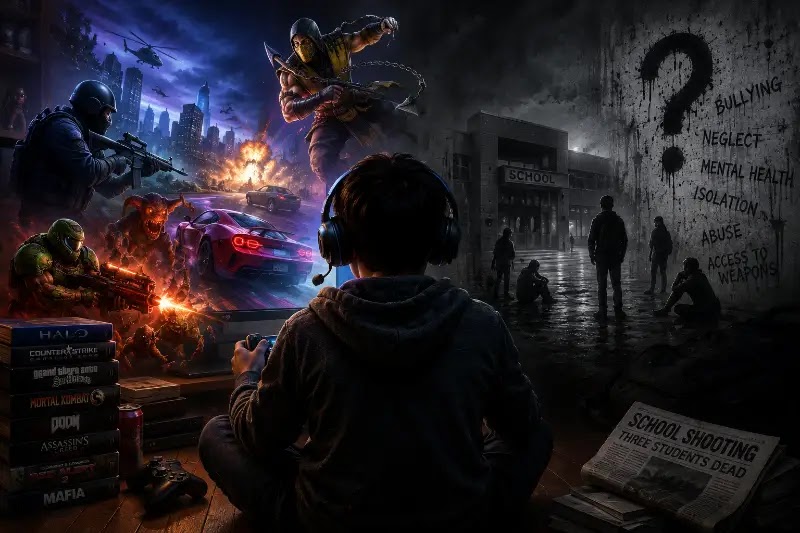
I grew up on Counter-Strike, Red Alert, Doom, Halo, Grand Theft Auto, Mortal Kombat, Assassin's Creed, Mafia, and enough explosions to make Michael Bay blush.
Today I'm a software developer.
Not the next Hitler.
Millions of Filipinos—and billions worldwide—grew up playing the same games. Most of us became engineers, teachers, nurses, artists, mechanics, parents, or ordinary people trying to survive another Monday.
If violent games directly created killers, we'd be living in absolute chaos.
Instead, they're enjoyed by hundreds of millions of people who never hurt anyone.
We've Been Hunting the Wrong Villains for Decades
This isn't the first moral panic.
In the 1980s, heavy metal music was supposedly corrupting America's youth.
The band Twisted Sister was dragged before the U.S. Senate, accused of encouraging violence, suicide, and moral decay. Their frontman, Dee Snider, defended artistic expression and argued that people were blaming music for problems that already existed.
Rock music survived.
Society survived.
Then it was rap music.
Then violent movies.
Then comic books.
Then Dungeons & Dragons.
Then the internet.
Now it's video games.
The target changes.
The pattern doesn't.
Remember Yuri?
If you grew up playing Command & Conquer: Red Alert 2, you probably remember Yuri.
A psychic dictator capable of controlling minds.
Ridiculous.
Fun.
Nobody finished the campaign and suddenly thought:
"You know what? Global domination sounds achievable."
Likewise, nobody heard the iconic Counter-Strike announcement—
"The bomb has been planted."
—and thought:
"I should go bomb a building."
They're game mechanics.
Not life lessons.
If exposure alone created criminals, every Doom player would be a demon hunter, every Flight Simulator player would become a pilot, and every FIFA player would qualify for the World Cup.
Reality doesn't work that way.
Duke Nukem Didn't Raise Me
I also grew up with Duke Nukem.
An over-the-top action hero who solved everything with impossible guns, terrible one-liners, and explosions.
Somehow, despite hundreds of hours of ridiculous violence, I never developed an urge to invade Area 51 or fight alien pigs.
Because children and teenagers don't become who they are because of one game.
They become who they are because of everything around them.
Their parents.
Their friends.
Their school.
Their community.
Whether someone notices they're struggling.
Whether someone steps in before it's too late.
The Tacloban Shooting Didn't Begin With a Download Button
A tragedy like the Tacloban school shooting doesn't emerge from a Steam library.
It emerges from a chain of failures.
Broken homes.
Bullying.
Untreated mental health issues.
Social isolation.
Warning signs that go unnoticed.
Easy access to means of violence.
Failures in intervention.
Those are difficult problems.
Banning a game is comparatively easy.
But easy doesn't mean effective.
Correlation Isn't Causation
The uncomfortable truth is that many perpetrators of violent crimes happened to play video games.
Do you know who else plays video games?
Almost everyone under forty.
Finding games on a suspect's computer proves about as much as finding rice in a Filipino kitchen.
It tells us almost nothing by itself.
The Boat Is Sinking
Imagine a boat with a massive hole beneath the waterline.
Instead of repairing the hull, everyone starts arguing over whether the paint color is causing the leaks.
That's what this debate feels like.
We're patching holes above the waterline because they're easier to reach.
Meanwhile, the real damage continues underneath.
Solve the Cause, Not the Headline
If we truly want fewer tragedies, we should invest in the things that actually change lives:
- Better mental health support in schools.
- Earlier intervention for at-risk youth.
- Stronger guidance counseling.
- Anti-bullying programs that schools genuinely enforce.
- Support for struggling families.
- Better systems for identifying warning signs before violence occurs.
Those aren't politically flashy.
They don't generate dramatic headlines.
But they're far more likely to prevent the next tragedy than banning another video game.
We've Seen This Movie Before
Every generation picks a new cultural villain.
Rock music.
Comic books.
Television.
Rap.
Video games.
Social media.
It's comforting to believe one thing caused a complicated tragedy because then the solution seems simple.
But simple answers are often wrong.
The Tacloban shooting deserves serious reflection.
Serious policy.
Serious intervention.
Not another round of blaming entertainment while ignoring the harder questions.
Because if we keep fixing the wrong problem...
we shouldn't be surprised when the next tragedy looks exactly like the last one.