Two Years of Willful Ignorance
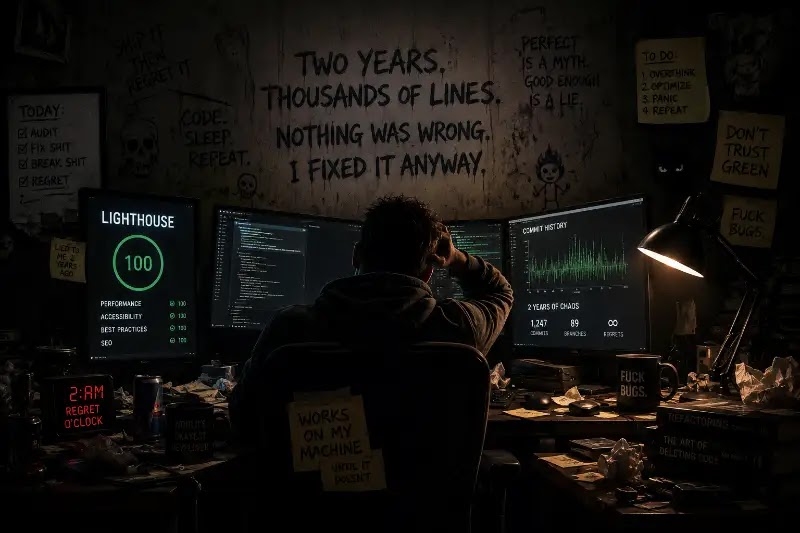
Two years ago, I opened Lighthouse.
Everything came back clean.
All green.
All pretty.
I looked at it, nodded like a responsible engineer, and immediately made what turned out to be one of the greatest technical decisions of my life.
I stopped looking.
Not because I was scared.
Okay... maybe a little.
Because every developer knows how this story usually ends.
You start with a clean project.
Then you add features.
Then more features.
Then "just one more thing."
Then six months later your website somehow needs a GPU, 4GB of RAM, and emotional support just to render a button.
I fully expected that's where this story was heading.
Then the Feature Creep Began
The site I had back then wasn't the same site anymore.
A backend.
A CMS.
A dashboard.
Authentication.
Analytics.
Comments.
Notifications.
SEO improvements.
Sitemaps.
Structured data.
Security headers.
Accessibility improvements.
Translation support.
Performance work.
Hundreds of commits.
Thousands of lines of code.
Enough refactors that Git probably deserves therapy.
Normally software follows a very predictable life cycle.
You build something.
You improve it.
It becomes slower.
Then everyone pretends Lighthouse is broken.
Opening Pandora's Box
Eventually curiosity won.
I clicked Analyze.
Immediately my brain entered bargaining mode.
"Please don't be 43."
"Please don't tell me one dependency imported the entire internet."
"Please don't expose the crimes I committed at 2 AM two years ago."
I already had the weekend planned.
Find thousands of problems.
Delete random packages.
Blame React.
Blame Google.
Blame JavaScript.
Blame whichever bundler was fashionable this week.
Repeat until emotionally exhausted.
Instead...
It looked...
...fine.
Which honestly annoyed me.
Trust Issues
Naturally I assumed Lighthouse was lying.
So I started auditing everything manually.
Then I audited the audit.
Then I reviewed the review.
Then I questioned whether the things being reported were even real problems.
Turns out...
Most of the remaining issues weren't even issues.
They were things like:
"This legal page should probably have its own metadata."
"This label should actually point to that input."
"Maybe don't greet lost visitors with a movie reference that Google Translate turns into complete nonsense."
That was it.
Two years of accumulated technical debt...
...and I'm arguing over a joke on a 404 page.
I've seen enterprise systems held together by caffeine, duct tape, and three developers silently praying nobody presses the wrong button.
Meanwhile I'm spending half an hour debating metadata on a privacy policy.
Software engineering is a fucking illness.
Arguing With a Robot
The funniest part wasn't fixing code.
It was arguing with AI.
"No."
"That's accessibility."
"That's not SEO."
"That's localization."
"Stop auditing things I never asked you to audit."
"We are fixing exactly four files."
"No, you are absolutely not refactoring the universe."
It eventually listened.
Mostly.
Then we optimized script loading.
Removed render-blocking resources.
Verified every change.
Verified the verification.
Ran smoke tests.
Reviewed the smoke tests.
Because apparently trusting your own code is no longer enough.
Now you also have to distrust the machine reviewing it.
The Weirdest Part
Somewhere in the middle I realized something.
Two years ago I celebrated adding code.
Now I celebrate deleting it.
Removing scripts.
Removing requests.
Removing unnecessary bullshit.
There's something deeply satisfying about watching a codebase get smaller while getting better.
It's like cleaning your room and discovering half the mess was empty Amazon boxes you've been emotionally attached to for no reason.
Peak Software Engineering
Then reality reminded me who was actually in charge.
After hours of performance work...
SEO.
Accessibility.
Translation.
Smoke testing.
Verification.
I suddenly remembered something.
"...wait..."
"...I never actually finished the contact form."
Hours optimizing the house.
Forgot to install the fucking front door.
Peak software engineering.
Two Years Later
Looking back, I think that's what I'm happiest about.
Not the reports.
Not the audits.
Not the graphs.
Definitely not the numbers.
The website survived.
Most personal sites become digital graveyards.
One excited blog post.
A few abandoned projects.
Then silence.
This one kept evolving.
Breaking.
Getting rebuilt.
Questioned.
Audited.
Simplified.
Improved.
Over and over again.
Not because it was perfect.
Because I kept coming back.
Sometimes software doesn't need another framework.
It doesn't need another rewrite.
It doesn't need another YouTube architect explaining why your stack is obsolete.
Sometimes it just needs someone stubborn enough to keep giving a shit.
Even after two years.
Especially after two years.
Now if you'll excuse me...
I'm going to pretend Lighthouse doesn't exist again.
See you in 2028.