← Back to Series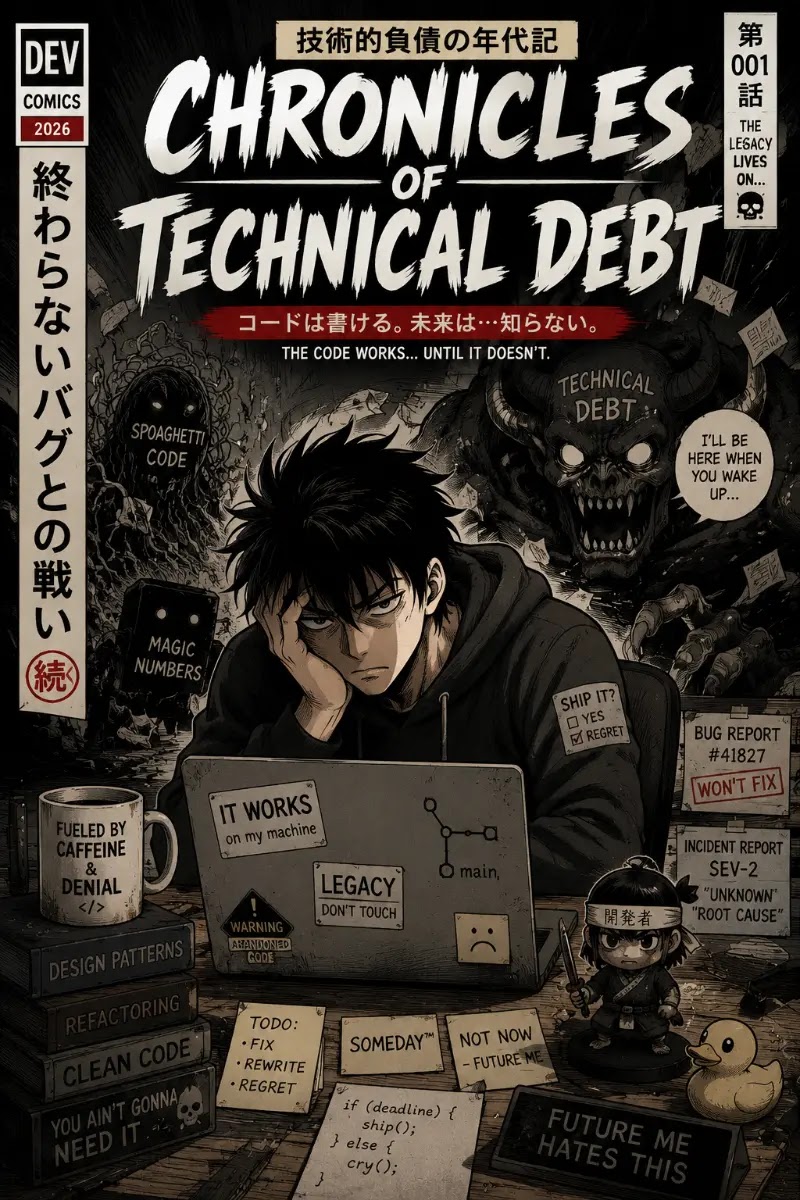
Chronicles of Technical Debt
Every codebase has a history. Some chapters are clean architecture and satisfying refactors. Others are legacy systems, production incidents, late-night debugging sessions, and technical debt that refuses to stay buried. Chronicles of Technical Debt follows those engineering stories—equal parts postmortem, architecture journal, and cautionary tale for my future self.
11Chapters
1h 10mTotal read time
CompleteUpdated Aug 2, 2026
Chapters(11 total)
1
I Accidentally Built a Publishing Platform
I set out to replace a few Firebase fetches with a backend. Somehow that escalated into building a full publishing platform with a CMS, search, reader features, production battle scars, and enough overengineering to make Future Me file a complaint.
~7m readJul 1, 2026Read Chapter →
2
I Finally Admitted My Portfolio Needed a Backend
I spent way too long convincing myself my portfolio didn't need a backend. Then the project grew, AI entered the picture, and my "simple" architecture wasn't so simple anymore. Four weekends later, I finally admitted defeat—and built one.
~5m readJul 3, 2026Read Chapter →
3
I Built the Backend. Then Production Humiliated Me.
Me: "The backend is done." Production: "Hold my DNS." A tale of Cloudflare gaslighting, Railway confusion, Next.js 404s, and enough infrastructure debugging to qualify as emotional damage.
~6m readJul 3, 2026Read Chapter →
4
The Most Valuable Code I Ever Wrote Doesn't Exist
The best engineering rarely ships as a feature. It's the boring stuff nobody notices - indexes, caches, backups, monitoring, and the annoying questions that quietly save everyone else's weekend. Production has a funny way of rewarding paranoia.
~8m readJul 15, 2026Read Chapter →
5
I Went To Sweep the Kitchen. 1 Week Later I Was Rewiring the House.
I went in to optimize one report. Three weeks later I was chasing `{}` payloads, 20 GB memory spikes, race conditions, Bull queues, Excel bottlenecks, and enough technical debt to qualify as a home renovation. Turns out the server wasn't haunted. Just... lived in.
~7m readJul 27, 2026Read Chapter →
6
I Finally Looked Again
Two years. Hundreds of commits. Thousands of lines of code. I finally opened Lighthouse expecting a crime scene and emotional damage. Instead, I found something worse: almost nothing left to fix. Turns out deleting bullshit is more satisfying than writing it.
~4m readAug 8, 2026Read Chapter →
7
THE GHOST ENGINEER WHO BUILT HALF MY PORTFOLIO
A forgotten engineer returns to the ruins of his own unfinished empire. The code was abandoned, the dreams were buried, and the ghost was blamed. Years later, the descendant awakens the ancestor’s creation — not for revenge, but to prove the machine was never dead. It was waiting.
~5m readAug 2, 2026Read Chapter →
8
The Rabbit Hole Wins Again
A story about the time I tried to stop storing base64 images in Firestore and accidentally built a platform.
~8m readAug 5, 2026Read Chapter →
9
The Day I Discovered My Past Self Was Actually Competent
I investigated a mysterious DNS issue, only to discover the culprit was myself from months ago. A story about canonical URLs, Cloudflare redirects, SEO obsession, and the terrifying moment when your past self turns out to know what he was doing.
~5m readAug 7, 2026Read Chapter →
10
I Added a Checkbox and Somehow Improved the Architecture
I wanted a simple “Share to Facebook” button. Naturally, this turned into a small architectural investigation involving publishing pipelines, Discord notifications, distribution targets, confirmation dialogs, backwards compatibility, and the uncomfortable realization that past-me had apparently neve
~7m readAug 7, 2026Read Chapter →
11
Thank You, Next: How a Tiny Dashboard Upgrade Somehow Became v2.1.0
Started at 8 PM planning a tiny dashboard upgrade. Four hours, one cache collision, a `Comments0` incident, mobile card layouts, a publishing checklist, and several questionable life choices later, I somehow shipped Dashboard v2.1.0. Personal dashboard. One engineer. Zero regrets. Probably.
~8m readSep 17, 2026Read Chapter →