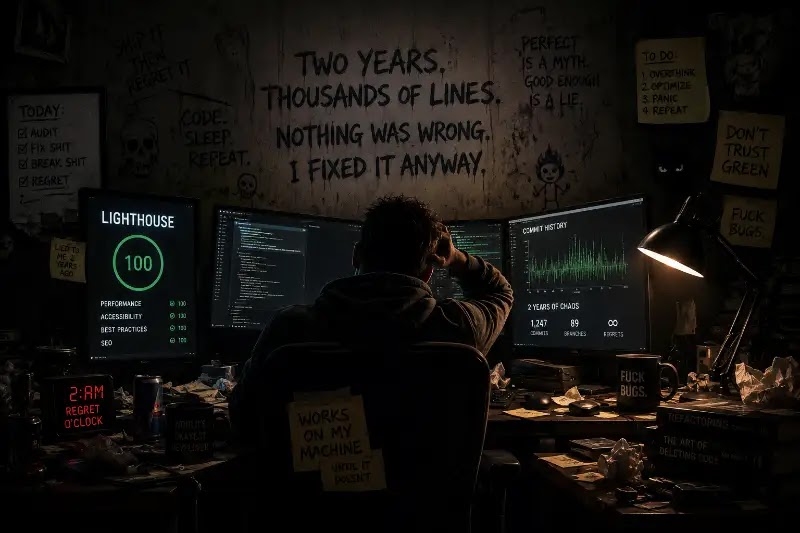
THE GHOST ENGINEER WHO BUILT HALF MY PORTFOLIO
The Ancestor, The Descendant, and the Forgotten Codebase That Refused to Die
[Black screen]
In 2024, a developer created a machine.
Not a very impressive machine.
Not yet.
A website.
A portfolio.
A collection of pages that loaded, buttons that clicked, animations that moved, and a suspicious amount of confidence.
The developer looked at it and thought:
"One day, this will become something bigger."
The universe responded:
"Sure. Put that in the unfinished projects folder."
And so it waited.
ACT I — THE FRONTEND PRISON
Once upon a time, there was a developer who knew how to make things beautiful.
The pixels obeyed.
The layouts aligned.
The animations danced.
The UI behaved.
He knew how to turn designs into reality.
He was a frontend engineer.
A title.
A specialty.
A box.
And boxes are comfortable.
Until you realize they have a ceiling.
The funny thing about being placed inside a box...
is that eventually you learn how to build the tools needed to escape it.
ACT II — THE SIDE QUEST FROM HELL
Every hero story needs a villain.
Not a cartoon villain.
Not someone wearing a black cape while laughing in a volcano.
Something much more realistic.
A normal-looking system.
A place where:
promises lived forever in meetings but mysteriously disappeared afterward,
growth was always "coming soon,"
responsibility increased faster than recognition,
and somehow the reward never matched the weight being carried.
The developer slowly started noticing strange things.
The side quests were becoming the main quest.
The workload was leveling up.
The character stats were increasing.
But the character screen still showed:
"Frontend Developer."
The developer asked:
"Can I explore backend?"
"Later."
"Can I work on architecture?"
"Later."
"Can I grow into more?"
"Later."
Eventually he discovered the ancient corporate spell:
"Just wait a little longer."
A spell so powerful it has defeated thousands of developers throughout history.
ACT III — THE MOMENT THE CHARACTER BROKE
The funny thing was...
the developer never stopped loving code.
He stopped loving the environment around it.
The curiosity disappeared.
The excitement disappeared.
The feeling of:
"Holy shit, I built this."
was replaced with:
"Please let this deploy successfully."
The problem was never programming.
The problem was slowly becoming someone who only survived tickets.
Then came the realization.
Maybe the developer wasn't tired because he hated development.
Maybe he was tired because he was no longer allowed to become the developer he wanted to be.
ACT IV — THE GHOST IN THE MACHINE
Years passed.
The developer opened an old project.
A project from another timeline.
Another version of himself.
A younger engineer who knew less...
but dreamed bigger.
And then something strange happened.
The old code started making sense.
There were breadcrumbs.
Little decisions.
Small architectural choices.
Random folders.
Half-finished ideas.
Things that looked like mistakes before...
but suddenly looked like plans.
The developer stared at the screen.
"Wait."
"Did I actually know what I was doing?"
The answer was complicated.
No.
But also...
kind of yes.
The ghost engineer wasn't a genius.
He was just someone who planted seeds without knowing what kind of forest they would become.
ACT V — THE INHERITANCE
The ancestor built the foundation.
The descendant inherited the responsibility.
The past version left behind a map.
The future version finally learned how to read it.
The thing that was once:
"just a Next.js portfolio"
slowly became something else.
A backend.
An API.
A dashboard.
Analytics.
Content systems.
Security layers.
Automation.
Infrastructure.
Performance work.
Deployment pipelines.
The boring stuff.
The beautiful stuff.
The painful stuff.
The stuff nobody sees until it breaks.
The website stopped being a portfolio.
It became a small production system.
And the funniest part?
The person who created the first version had no idea how much work they accidentally assigned to future him.
ACT VI — THE FINAL BOSS WASN'T THE CODE
The final boss was not the old workplace.
Not the limitations.
Not the people who underestimated him.
Not even the unfinished code.
The final boss was the belief that maybe this was all he could become.
The person who was once told:
"You're just frontend."
became the person worrying about:
API contracts,
CORS policies,
infrastructure,
caching,
observability,
security,
clean architecture,
version control,
maintainability.
The developer who was given one room...
ended up learning how to build the entire house.
END CREDITS
Past Me:
"Sorry about all the unfinished stuff."
Future Me:
"You left me a nightmare."
Past Me:
"Sorry."
Future Me:
"..."
Past Me:
"But did it work?"
Future Me:
"Unfortunately."
POST-CREDIT SCENE
Somewhere in an old project:
A forgotten TODO still exists.
A mysterious config file waits.
An environment variable from another era whispers:
"Future me will handle this."
Future me did.
Eventually.
After several crashes.
Several questionable decisions.
And approximately seventeen moments of:
"What the fuck was I thinking?"
But that's the thing about old code.
Sometimes it isn't technical debt.
Sometimes it is a message from a previous version of yourself.
A younger engineer saying:
"I couldn't finish this."
Not:
"I failed."
The ghost was never the problem.
The ghost was the reason the sequel existed.
The ancestor built the foundation.
The descendant finished the story.
And somewhere, 2024 Maiko is probably still wondering why 2026 Maiko is complaining about environment variables.
"Bro. I literally left you the instructions."
"You left me chaos."
"Same thing."
End credits roll.
A forgotten .env.example file gets its own spin-off.